“Divertimento”1
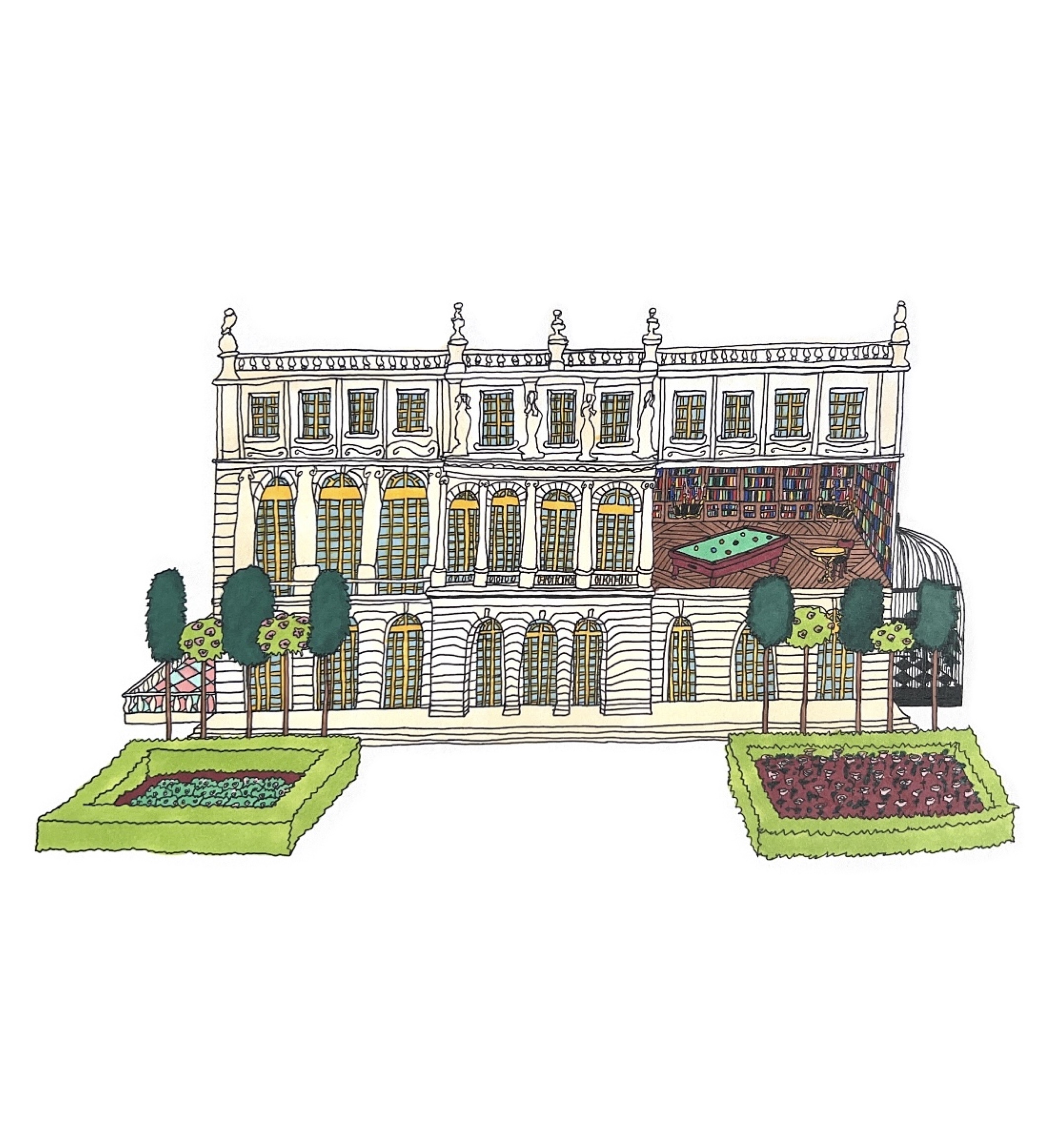
A. Premise. In the summer, the residency cohort will take an overnight trip to one of the region’s chateaux.2 After dinner together, each resident will give a speech about, provide examples of, and demonstrate what it would mean to joke in their medium.
B. Premise of the premise. Through the joke, the teller secretly plants something, an “object,” in the unconscious of the listener and then later draws it out.3 In some cases,4 the teller doesn’t have to plant anything, because culture or an immediate, shared situation has already done so, or an individual listener has already done so to himself, and the joke teller’s talent lies principally in sensing what’s already there.5 However the object gets inside the listener, the sound of it leaving the body is laughter.6 A joke is about pointing to something that is hiding in plain sight. It’s a surprise that only in retrospect is more worthy of being expected than what was expected.7 To go even further, when you “get” a joke, you realize that you did expect what you didn’t expect. Getting a joke is to suddenly feel the distinction between the conscious and the unconscious, because it’s revealed that the unconscious held matter that the conscious let pass through itself altogether, until released as laughter. The “punchline” might be so called because that’s the moment when this matter is by an external force displaced from the listener, like spit from a blow to the stomach.8
C. Premises. The symposium on jokes will take place in an environment tampered with. In the preceding weeks, residents will draw from a hat pieces of paper, on which will be written the name of a different space in the chateau or its grounds—e.g., library, conservatory, rose garden, terrace, cellar, etc.9 In the days preceding the symposium, each resident will go to the chateau, granted privacy from the other residents, to install in their assigned space a “joke” of their own design. These jokes may use the physical and cultural properties of their spaces and may employ any medium and play on any of the senses.10 ... Mirrors, trompe l’oeil, confusing signage, forced perspectives, strongly encouraged perspectives, buttons connected to nothing, hardware like body parts, droll dioramas in dumbwaiters, dramatic thresholds into broom closets, phantasmagoria. Throughout the evening of the symposium, each resident will encounter for the first time all the jokes that have been embedded in the chateau by the other residents. The loading of these formal premises with disarming technics is inspired by the Renaissance and Baroque practice of “water tricks.”11
D. Promises. Joke techniques involve playing with structure, timing, logic, tensions between illusion and disillusion, concealment and revelation, and expectation and surprise, and the secret orchestration of a hide-and-seek courtship of the audience’s unconscious and conscious minds. These are games that enliven art whether or not a laugh is sought. This summer night and the preparations it requires will provoke the residents to think about their disciplines and mediums in these terms.12
[1] Meaning “fun” in Italian; also a kind of lighthearted music for small ensembles that flourished in the 18th century. Right away, the jury of this serious institution with a sombre, publicly stated orientation to the social role of the artist in the context of the climate crisis must construe this applicant as being either deliberately irreverent or obtuse. Where is he going?
[2] Does the applicant understand how much it would cost for 40 people to spend the night at a castle? If the jury could provide feedback—or career advice—it might refer the applicant to a number of well-known European art residencies that are already set in castles.
[3] The applicant understands why it’s called a “premise” (pre-mise, from French “mettre,” to place, therefore to place in advance). He seems to have in mind “joke jokes”—self-contained, prepared compositions, distinct from jokes dependent on impromptu observation. Sometimes joke jokes are attributable to an author. Other times they just exist, like folktales, fairy tales, and myths. In those forms, the structure is so crystalline that, like a joke joke, the piece can be passed from teller to teller intact despite each teller’s unique inflections (assuming those inflections don’t ruin the internal logic of the piece, and may even illuminate that logic, as we can see in Norm Macdonald’s protracted, Dostoyevskian telling of the “Moth Joke” during a 2009 appearance on The Tonight Show with Conan O’Brien). Just as unsurprising, then (given this affinity), is the existence of folktales, fairy tales, and myths that are, structurally, jokes. An example would be (recorded in Calvino’s Italian Folktales) the Monferatto folktale “The Parrot,” a story that never really starts because it is repeatedly interrupted by a story-within-the-story.
[4] Just to elaborate on that last point... One aspect of the beauty of “The Parrot” as a joke lies in its way of drawing out the planted “object,” to use the applicant’s term—in this case the parrot and its loquacity—over and over again. The parrot is initially introduced as something ancillary to what is set up as the main narrative thread—a young female protagonist’s impending struggle with a predatory king who wants to kidnap her. But the parrot’s propensity to speech, manifesting as an interminably meandering fairy tale told to the protagonist, ends up blocking the king’s scheme, becoming a negation to the unfolding of the story that the reader was conditioned to expect to unfold. “The Parrot” thereby luminously over-stimulates one element of the general joke structure, the “punchline,” through recurrence. But it’s a punchline that can only be delivered through recurrence, for it is the recurrent speech of the parrot and the effects of that recurrent speech, rather than any one thing the parrot says, that is the joke. It has the effect of a diversion so insistent that it becomes the primary path, indeed the path by which the protagonist is unwittingly allowed to elude the scheming king altogether.
[5] Should the applicant reapply to the residency with this same proposal (in the wake of the residency’s rejection of it), or find a venue more hospitable to his idea, or perhaps find a way to publish it, it would be advisable for him—and in keeping with an aspect of his own idea for the evening he describes in section “A” of the proposal, namely: providing examples of the ideas discussed—to provide examples of the ideas he’s discussing. For example, if it were me, I might, on the point of the joke teller not having to plant any objects but only to identify ones already planted, say that wit depends on this sensitivity to already planted objects, and I would provide an illustration thereof: What comes to my mind is Stavros Halkias, who once accurately determined that an audience member had wealthy parents, with the observation that this audience member had a “rich neck.” Halkias’ technique of crowd work is based on his almost oracular ability to see what his audience is trying to conceal and to draw attention to the imperfections, and in some cases, quite beautifully, the needlessness, of those concealments. Therapy. I think also of John Cleese’s theory of humour: the belief that you are successfully hiding something that you are failing to hide. Leakiness.
[6] Italics…
[7] I often have this thought when listening to Bach.
[8] Or food from the Heimlich. A potential problem with the theory that the violent imagery in comedy trade language—“I killed,” “I slaughtered”—indicates latent destructive rage in the comedian is that it contradicts the experience of the laugher, which is one of overflowing vitality, and of the spirit of many comedians, which is life-affirming. Yet, we’ve all said we “died of laughter.” There’s the matter of inextricability, of one thing stirring its opposite. Few things animate like death. Run for your life, stopping to smell flowers. Copulating after brushes with evisceration. Hands on necks for loving smiles. Picnics and tongue kisses in twilit necropolises. Somersaults through epitaphs. She felt they laughed. I thought they clapped. Munch’s Dance of Life: future ghosts, fleshing one another out in wobbly circles while flesh they do, for now, still have. The moon floats in just above the sea, to reap them from the shore with lactic gravity, they’ll drown, drown with little sailboats lost above their rotting brows. Edvard’s entire body of work. And later that night we had another picnic.
But perhaps it’s not “slaughtering’s” extinguishing of life that is the point of the metaphor, but rather the physical symptoms it elicits—the releasing of blood and viscera—which pictorialize the exit of things hidden in the body, propitiated by the joke. While I’ve never bled from laughter (though some do), I’ve cried, drooled, ejected snot, peed, farted, and shat. And while I’ve never laughed so hard I came, I have come so hard I laughed. A laughing body shares with a body undergoing violence what really living shares with dying: the escape of internal juices. And, as does one sinking in fluid, the laugher gasps for air. A room laughing would not be well described as dry. We might even classify laughter as a bodily fluid.
And even if there were jesters driven by violence, there’s something funny in the fact that the more they’d try to “kill” the more they’d bring to life.
[9] A highly specific image—things being drawn from a hat. The applicant could have said simply that residents would be assigned different spaces. But he characterizes jokes as pulling things out from an unconscious—from a head. We must take only a nuanced credit for symbols of which we were probably not lucid at the time we let them through.
[10] Again, add examples. They don’t even have to be complete ideas. Just some evocative phrases will do. Materials. Elements. Inscriptions.

[11] “Between the ponds [...] are hidden certain little taps of brass. Thus, at any time when ladies may go to divert themselves by seeing the fish play about the pond, it needs only the letting go a certain spring to make every tap [...] send a jet of water straight upward [...] and drench the petticoats and cool the thighs of the ladies. [...] and there is set up a Latin inscription: Quæsisti nugas, nugis gaudeto repertis.” (From Montaigne’s travel journals, Italy, 1580-81).
The inscription means: You were looking for trifling amusements; here they are; enjoy them. Montaigne’s Essais have the same spirit: joyful embarrassment in sophisticated settings.
The applicant has a lot he wants to say... “Water tricks” entailed hiding water spouts in courtly gardens—in the ground, in bushes, in statues—for the purpose of dousing unsuspecting garden-goers. Of course, given the prevalence of this practice during its flourishing, the visitors must have let themselves be unsuspecting, naive, to some degree, like children do as they leave childhood. The applicant’s proposal would be more compelling were he to discuss and not merely mention water tricks. He posits them as a technical and social predecessor to the installations that his proposed lab would yield, but he does not play with the resonance between them and his own characterization of the joke as an instance of something hidden bursting out fluidly. Not to mention the fact (which I already mentioned) that many struck by water tricks would have been giddily aware that they were walking into an ambush, much like a listener into a joke, a crowd into a comedy.
For a moment it was starting to feel clear why the applicant wants to set his symposium in a venue offsite: to afford each resident secrecy during the installation of their joke. But it hardly ensures that any more than if they used the residency building itself instead of an offsite castle. They still have to share the space. He wants his would-be fellow residents to use what’s already there (pre-mise) in the premises of the chateau, but he isn’t doing that in the construction of his proposed scene. The chateau isn’t already there. Even if it were... 40 people, already busy with their own residency projects, installing jokes in secret from each other? Prohibitive impracticalities. The solution is not in elaborate logistics allowing the residents to hide the formulation of their chateau jokes from each other, but in changing the premise of from whom those formulations are to be hidden: Let the residents see each other at work. Let them work together. They aren’t to hide from each other. They aren’t to hide things in each other. Then, invite the public in for that summer night. Hide things in them. Draw things out of them.
As much as this is my idea, it’s the applicant’s. It’s embedded in his own key reference, but he didn’t see it: water tricks—they were to play with the formality of visitors to the gardens, not the residents, not the hosts. You dress in layers and walk in stately ways. You nod slowly and go Mmmm. You say something about Montaigne. You lean in and smell the peony. Wetness down your neck. Lean in and watch the fishes. Wetness up your crotch. Draw near the hedge to better see the chiselled face it overgrows…
[12] One of the three main failures of this proposal is that it is less for a workshop at a residency and more for a whole new residency. It imagines a concerted study and production of interdisciplinary jokes by an isolated group of artists. And it uses water tricks as a precedent. Earlier this summer, I shot a movie called Water Tricks. About a princess. Made with friends reclusively over a month on a country property with a big hedge around a garden. Full of jokes. I always thought of the project as a residency.
Second failure: The applicant was not working with the materials that would be available to him. The chateau is his fortress of delusion. A place of self-exile, protecting him from rejection. All of my suggestions would be pointless if the applicant wasn’t truly ready to be accepted. We didn’t have a castle either. We made one by dressing a little woodshed in fabrics. We leaned into the incongruity of scales between body and space, like some majestic figures painted by Van Eyck. The cat that was meant to be in the movie was too nervous. We used a puppet.
This summer night ... will provoke the residents to think about their disciplines and mediums in these terms. But what else could it provoke them to think about? The third failure is that the applicant didn’t once mention the climate crisis. The thing is: it’s in there. Gardens, water, expulsion of unconscious matter. Repressed fears. Fears of planetary deformation. Fears repressed by all. The applicant’s residency could naturally address this, precisely by drawing out certain themes and references that so far only faintly appear in his proposal. For example, the theme of the joke’s ability to get the body to release things suggests a broader construal of humour as an art of playing with openings. It doesn’t just open bodies, it leads them to openings, ones they might be afraid of. Divertimento. Diversion. It’s how we think of fun and humour. But on a path avoiding dreadful openings, a diversion could lead toward one.