Leonardo Drew began his career drawing action figures in the 1970s. His first exhibition, at age 13, caught the attention of Marvel and DC Comics, who offered him a job as an illustrator. “Then I saw Jackson Pollock’s work in a black and white library book,” Drew has said, “and I knew I was doomed.” Pollock, and a visit to the Picasso retrospective at MoMA in 1980, gave him a feeling for the possibilities of abstraction. He began experimenting with three dimensional forms and unusual materials, suspending things like rope, dead birds, and animal carcasses from wooden supports. While he was a student at Cooper Union, he “cooked” 1,200 metal boxes in his apartment (“I’m an artist,” he explained when the fire department found him in his kitchen). This “weathering process,” whereby Drew “injures” and “decays” new materials to make them look like found objects, defines his sculptural abstractions. As does his decision to use numbers instead of words in his titles: the viewer, he believes, should experience and complete the work on their own terms. When I spoke to Drew before his lecture at Principia College last year, he had flown in from his ranch studio just outside of San Antonio, where he has been “taking in the largesse of our existence” (that is, the night sky) without light pollution. “It’s difficult to do that in New York.” It’s difficult, also, to talk about Drew’s work without looking at it, and I had to put a few prints on the table to guide my questions. This conversation was edited and condensed for clarity.
–Sky O'Brien
Leonardo Drew is known for creating reflective abstract sculptural works that play upon the dystopic tension between order and chaos. Recalling Post-Minimalist sculpture that alludes to America’s industrial past, as well as the plight of African Americans throughout U.S. history, one can find many meanings in his work. Ultimately the cyclical nature of life and decay can be seen in his grids of transformed raw material to resemble and articulate entropy and a visual erosion of time.
Drew’s natural talent and passion for art was recognized at an early age, first exhibiting his work at the age of 13. He went on to attend the Parsons School of Design and received his BFA from the Cooper Union for the Advancement of Science and Art in 1985. His works have been shown nationally and internationally and are included in numerous public and private collections. Public institutions include the Metropolitan Museum of Art, New York; The Museum of Modern Art, New York; The Museum of Contemporary Art, Los Angeles; The Hirshhorn Museum and Sculpture Garden, Washington DC; and Tate, London, among others, as well as collaborating with Merce Cunningham on the production of “Ground Level Overlay.” New York Times art critic Roberta Smith describes his large reliefs as “pocked, splintered, seemingly burned here, bristling there, unexpectedly delicate elsewhere. An endless catastrophe seen from above. The energies intimated in these works are beyond human control, bigger than all of us.” He currently lives and works in Brooklyn, NY and San Antonio, TX.
DM: You’ve described your sculptural abstractions as “configurations.” Does that word apply to all of your work or just what’s on the wall?
LD: A lot of times the base of the work is a grid. For me, the most practical way to bring all the elements together, to compose and create on a relatable palette, is the square. You wouldn’t think it’s mathematical because the surface is so chaotic. But the base is mathematical. The way I work, nothing is sacred. The work can be dismantled. I can take a square from one piece and put it into another one. It fits because they’re all on the same type of base, with the same measurements. I call it a super additive. I can continue to add one to the other to make the next configuration.
All of your work expands from a grid.
Endlessly.
You use natural processes like rust and decay to transform your materials in the studio. You’ve said you “become the weather.” Do you think of your configurations as natural landscapes?
We are not separate from nature. We are not on the edge of it. We are a part of this whole cycle of cosmic realization. We are it. For me to say I become the weather—there’s a redundancy to that. Because the fact is there’s no separation.
There’s a temptation to take your work literally. A write-up about Number 130, for example, says it shows a “burned and deteriorated urban landscape.” But I don’t think your work is that literal.
No, it’s not. Most people catch up later that these things are dyed or washed into that “burned” complexion. But if I were to actually burn it, you would park it right there and walk away. Burning has a whole other connotation. Heavy. Dark. A lot of times people assume it’s burned and walk away.
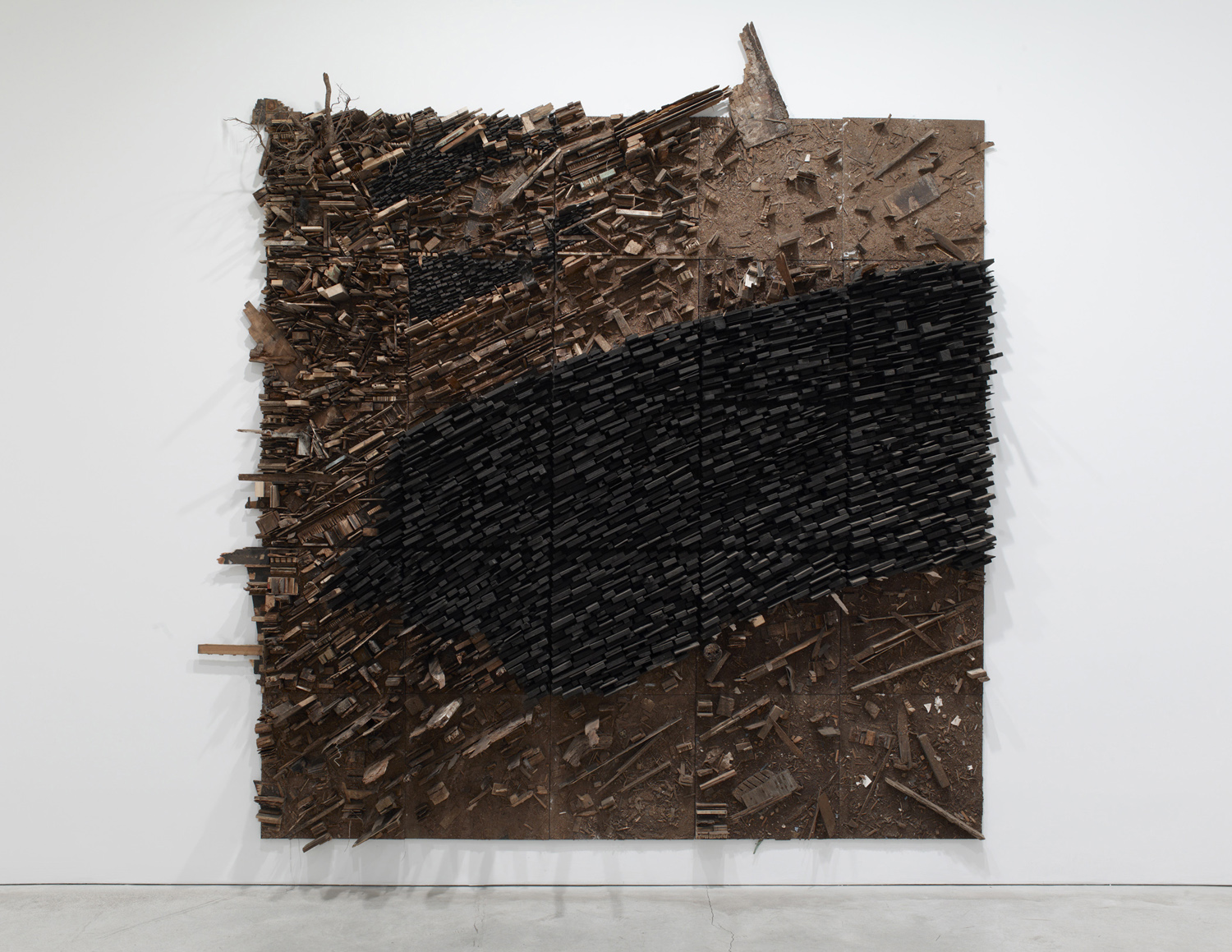
Much of your work feels other-than-human. When I look at it, I understand that it’s not a human thing. When it speaks to me, I don’t know what it’s saying, I’m tuning into something without words.
I definitely want you to elaborate on that.
The abstractions have their own agency, their own aliveness that is beyond the human. You assemble the parts in their own configuration. This configuration is a language. It’s like when I look at a tree: I see it’s a tree, but I don’t know what a tree is.
You're not a tree.
Just like I’m not Number 130. And yet the work invites contemplation. I’m given a chance to contemplate.
That’s the gist of the whole thing. You are put into a position where you are abstracted from the self. If you want the literal—if you want something explained, if you want things to be straightforward—you are now put in a precarious position where you have to re-evaluate who you are up against this thing. This is what the best art does. It pulls you out of your comfort zone and places you in a position where you have to deal with something. Like a Richard Serra. You stand in front of a Richard Serra and this thing looks like it wants to collapse on you. That tension is putting your body into a predicament. When we were in caves, we hid from the dark because things out there wanted to eat us. Now people say, Why am I afraid of the dark? Well, there’s a reason why that fear is implanted in our DNA. So when you are standing in front of something unknown, it activates that fear. The best artist actually knows how to hit that note, that thing that we all are part of. That unknown otherness that unnerves us. It might just be a primal thing.
When I walk through a Richard Serra installation, my experience of sound changes. Do you think about the experience of sound in your work?
If you’re building a composition that’s three dimensional, you can trigger different sounds through the cavities that you put in. You can run notes, almost musical, and sort of play on where you pull out and where you push in within that three dimensionality. You can get the body to almost play like a drum. This is the beauty: understanding the correlation between poetics, music, and visual art.
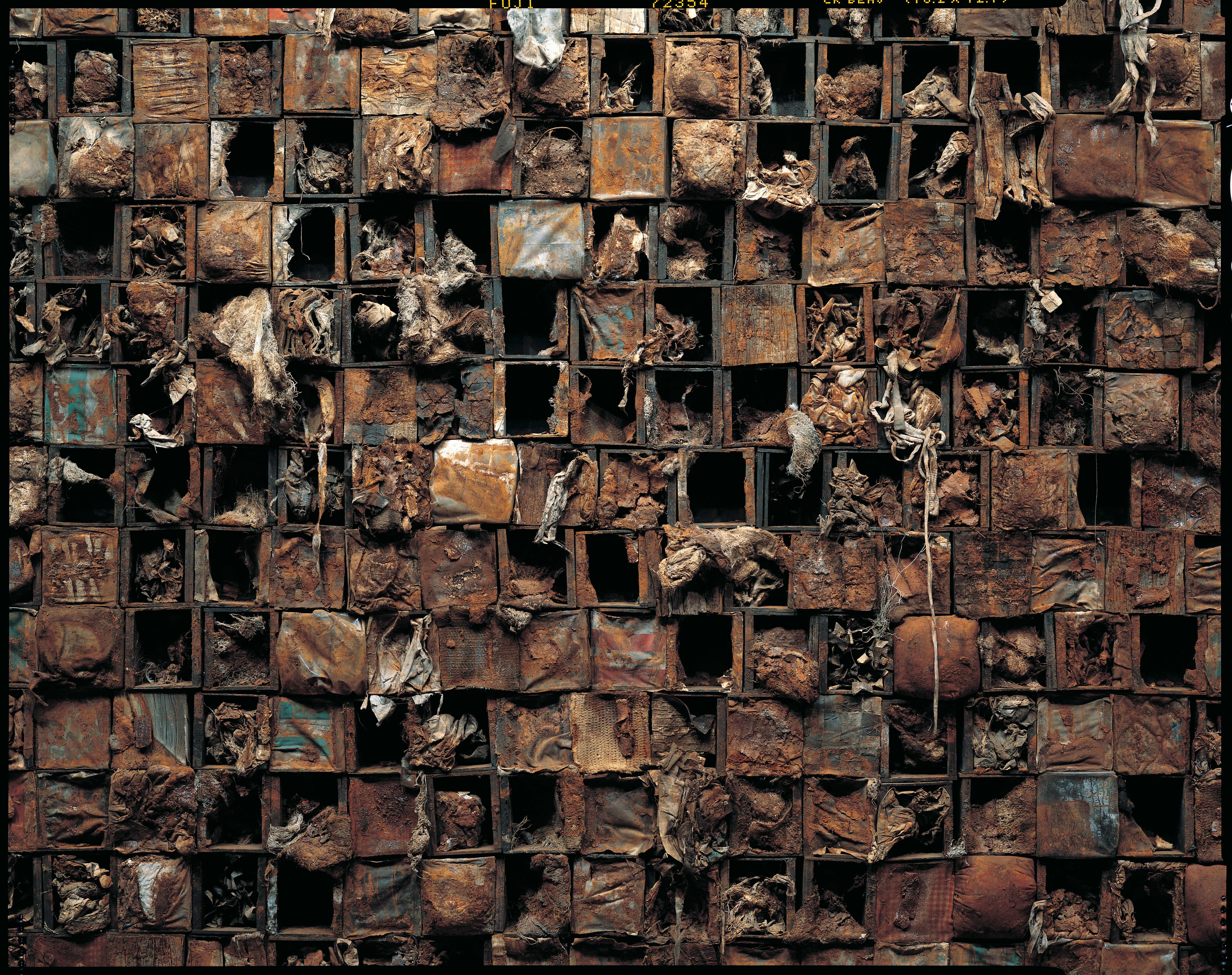
Is there a piece or a configuration that comes to mind?
The rusted boxes in Number 43. There’s this build-up of holes. In that one, the composition is based on what I believe to be a normal sense of decay. If you saw decay in any other place, you would probably realize that there can be beauty when things collapse, like after a tornado rips through a place. It’s horrible, but at the same time, you realize nature has no bounds. Something has been completely wiped out. You get the sense in a lot of ways that nature is the master. It can create masterpieces. If you’re viewing it without the sense that there was a disaster, you would be looking at a masterpiece. Look at an aerial view of a Mark Bradford, for example.
Speaking of Mark Bradford, his titles hint at what the work is saying. They’re poetic. Whereas you use numbers in your titles.
They are numbered so that you can have your full-on experience as the viewer. You’re complicit in realizing these things. I should not be getting in your way. You need to have an experience. In that way, I can learn from you. I’m not ever going to exclude the viewer in terms of completing the work.
I wanted to ask you about corners. In a few places you use walls in a corner formation. There’s Number 305 at Lelong in 2021. And then Number 341 at Art Basel in 2022, which is almost an inverted version of what you did at Lelong. What does the corner allow you to do?
A lot of artists will tell you they’re not going to allow space to dictate what they create. That’s crazy. If you’re actually going in and understanding the composition of a three-dimensional situation, it’s going to influence how you build something in that space. There has to be a conversation between what you’re creating and what’s around it. When I built a city in the grass, so to speak, in the middle of Madison Square Park in New York, it was being framed by the Empire State Building on this side, the Flatiron Building on that side. You need to contend with that. Otherwise it’s going to completely erase whatever your little thing is. Those corners are something you take advantage of. You don’t try to overtake it, you build into it.

But you constructed the corner at Art Basel.
They didn’t have a wall. They forced you to take on this big space, but each one had to be partitioned. I saw the space, and then I looked at the surrounding and built within that space.
You didn’t have any idea what you wanted to do before?
I had all the material. Number 341—there have been five or six different iterations of it. And you may not even have been aware of it. If you see other pieces like it, it’s probably the same piece. The material is the same but it’s been configured differently. Those materials at Art Basel came from the piece at Lelong.
Really?
That’s the same piece. I just flipped it on his head. It’s mixed in and you wouldn’t know it. I see it as just material.You are seeing it as a means to an end. I’m always, one way or another, playing into the idea that these things are not sacred. That they can go on to have different iterations. And hopefully become stronger iterations each time, like muscle. Each time I’m learning more about their capacities.
The way that you use materials reminds me of how Joseph Beuys used materials.
Beuys. Jackson Pollock. Kiefer. We go on and on about Serra. All the artists who explore and invade space in ways that are insightful. I’m standing on the shoulders of all these artists. I’m not breaking a line. I know the potential of how Beuys will take on different materials, but he does it with a lot more intent than I do. There are so many dimensions to each approach. It’s inescapable that we’re walking into this hand in hand.
Here’s another corner. Number 28.
In Sienna.
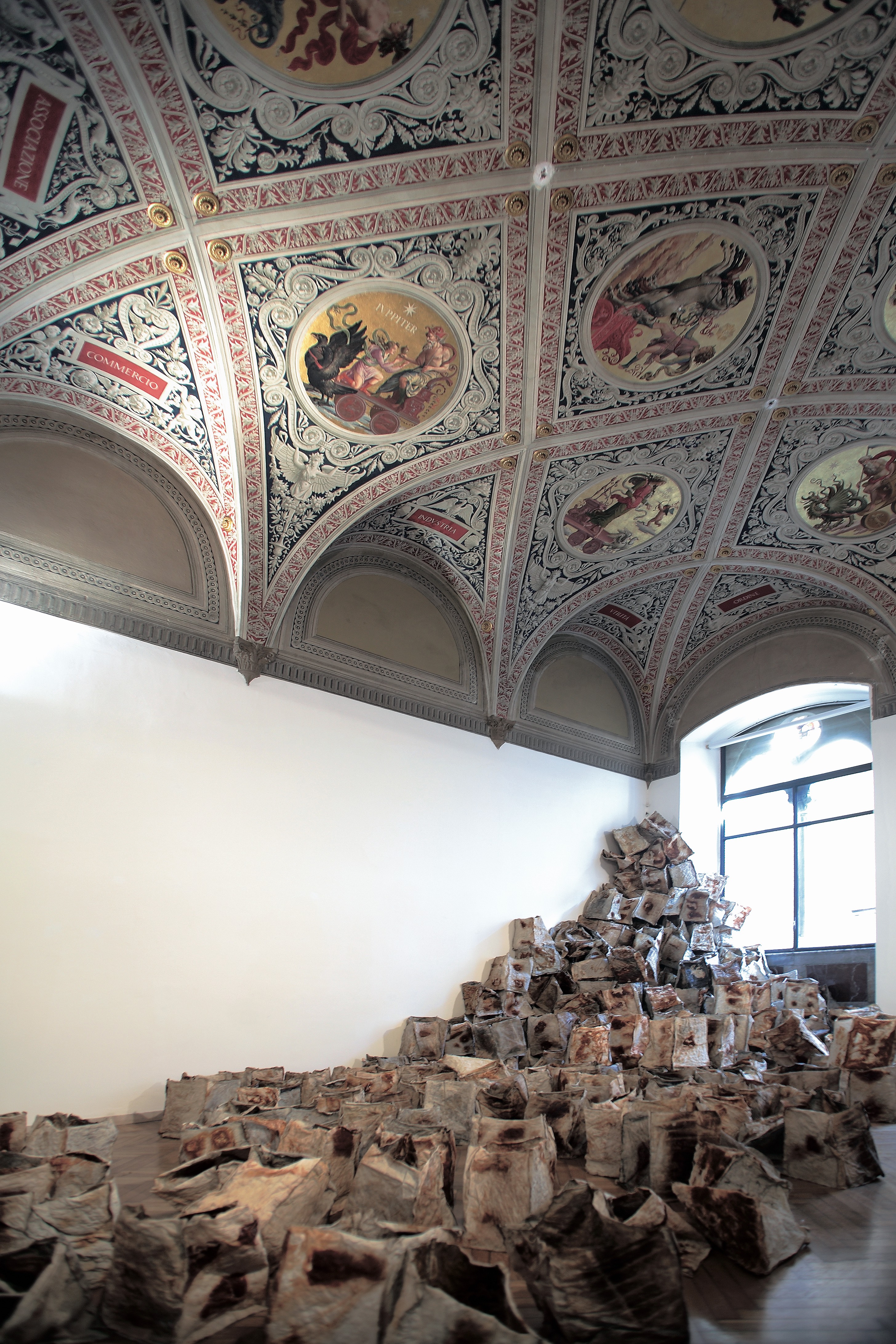
This piece is gorgeous under the ceiling at the Palazzo delle Papesse.
How it speaks to the ceiling, almost like an hourglass. Like I said, the architecture can be a super additive to the final piece.
Some of your other works on the wall, like Number 181, remind me of text formations. They look like prose. Can you talk about the process of creating these “texts,” or the suggestions of text, on the wall?
Keep in mind that we are a part of a collective consciousness. If you have a relatable motif, you will be able to make an association. So if I do something like this in Braille, and you have your fonts in place within this context, eventually you will come to know it from some place. Like biblical tablets. Through these different motifs you can pique a collective consciousness. It can be easily played on. I mean, Number 181 is obvious. Working trees into it you can lead the viewer into even bigger avenues of discovery. There are familiar things and then the things that abstract that familiar thing.
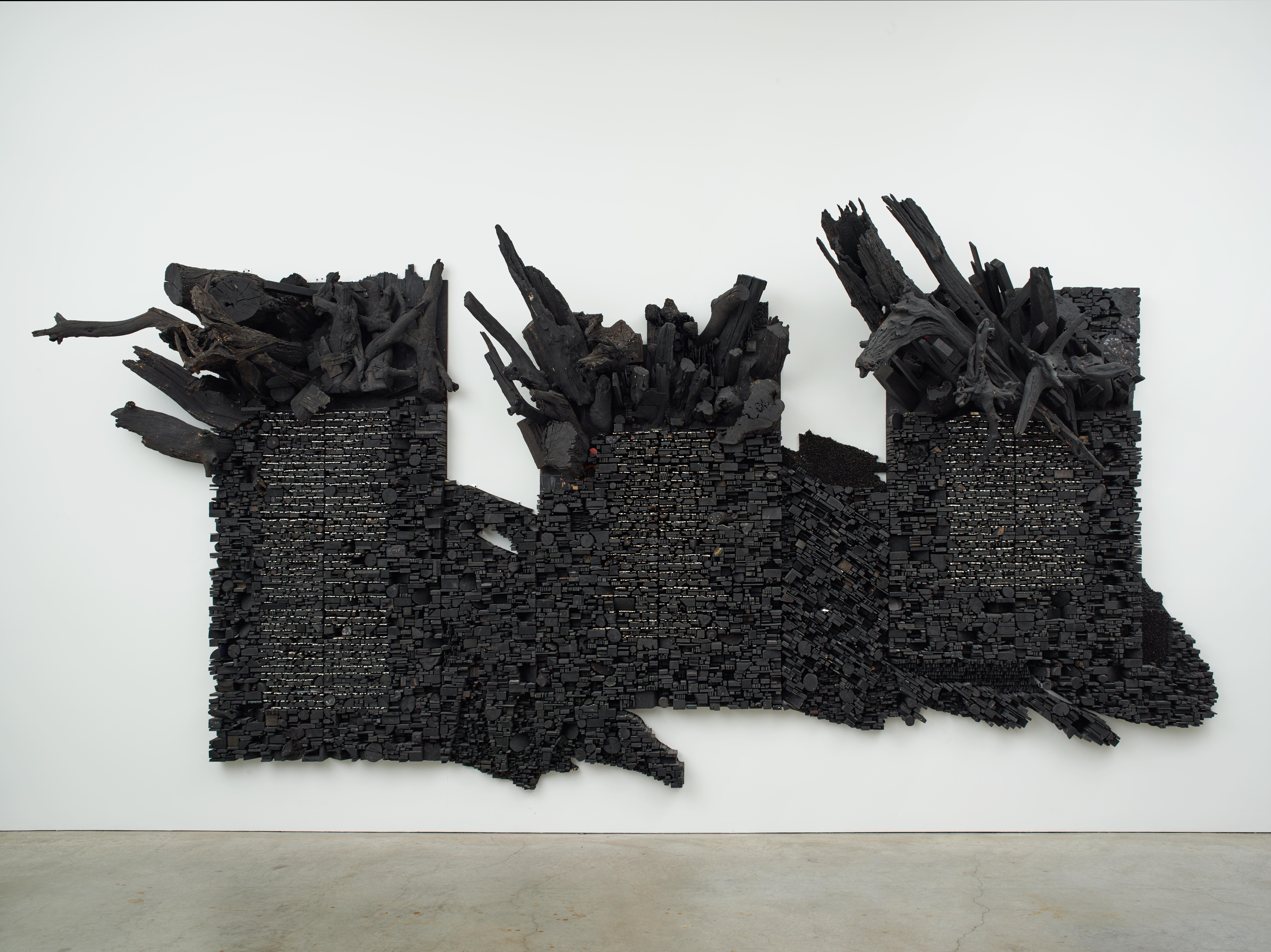
These aren’t actually words. The blocks suggest words. The content is unstated, but there’s a biblical sense: tablets, scrolls, and the tree branches could suggest a crown of thorns. But I might be reading too much into it.
You’re reading it. That’s the thing. I’m getting out of your way.
And these are still working with the grid, right? You’ve spoken about Mondrian and how his grid is central to your configurations.
He’s buried in my neighborhood. Right down the street. I mean, my goodness, when you talk of masters of the grid and color. Now we are taking his formations and turning them into fashion—and he died in poverty! But these discoveries are long-lasting. Commitment to your craft can lead you to these places. Eventually your public will catch up. But the fact is you need to explore, sometimes to your own demise.
Demise?
You think of Mondrian. Van Gogh. There’s a commitment to something even though no one is on the same page as you. But you need to make your art and it can place you in a dangerous place. I have artist friends who are more on the deep end of this. I know that I could be there, but I had saving graces because people were collecting me when I was a kid. They’re still collecting me. Even though I continue to diversify, to change the work, to not add signatures to the work. But imagine now if you’re an artist that has to play only in one field and continue to mine this one field and not get any support. That can lead to depression and disappointment. I always tell artists that the gift is the making. Don’t allow the public to dictate whether you’re successful or not successful.
Is that part of why you stopped using cotton in your work?
After I made the cotton work, I was ready to move on. I’d answered all the questions that I needed to answer with that material. I could’ve definitely parked it right there and kept making cotton works. And people would’ve been like, Oh, Leonardo is the guy that makes these very political statements with cotton. But holding yourself in that position is not a good idea, especially as a young artist.
Is your “weathering” process still the same, or has it evolved?
It continues to evolve. Even the things that I’m doing now with broken mirrors, which are influenced by the kind of light I’m getting on the ranch outside of San Antonio. There’s a lot of space and no light pollution and I can see the stars. I knew that when I decided to find another space that wasn’t New York the work would evolve, and it’s starting to happen. One of these new works is on the cover of Art & Object Magazine. You need to see it in real life because the photograph doesn’t give you the reflection of the mirrors, which is explosive and has a disco effect if you hang it in your house. There’s a level of risk in that kind of work because you’re making something that will invade space in a way that is not traditional. It’s like stars all over your walls.
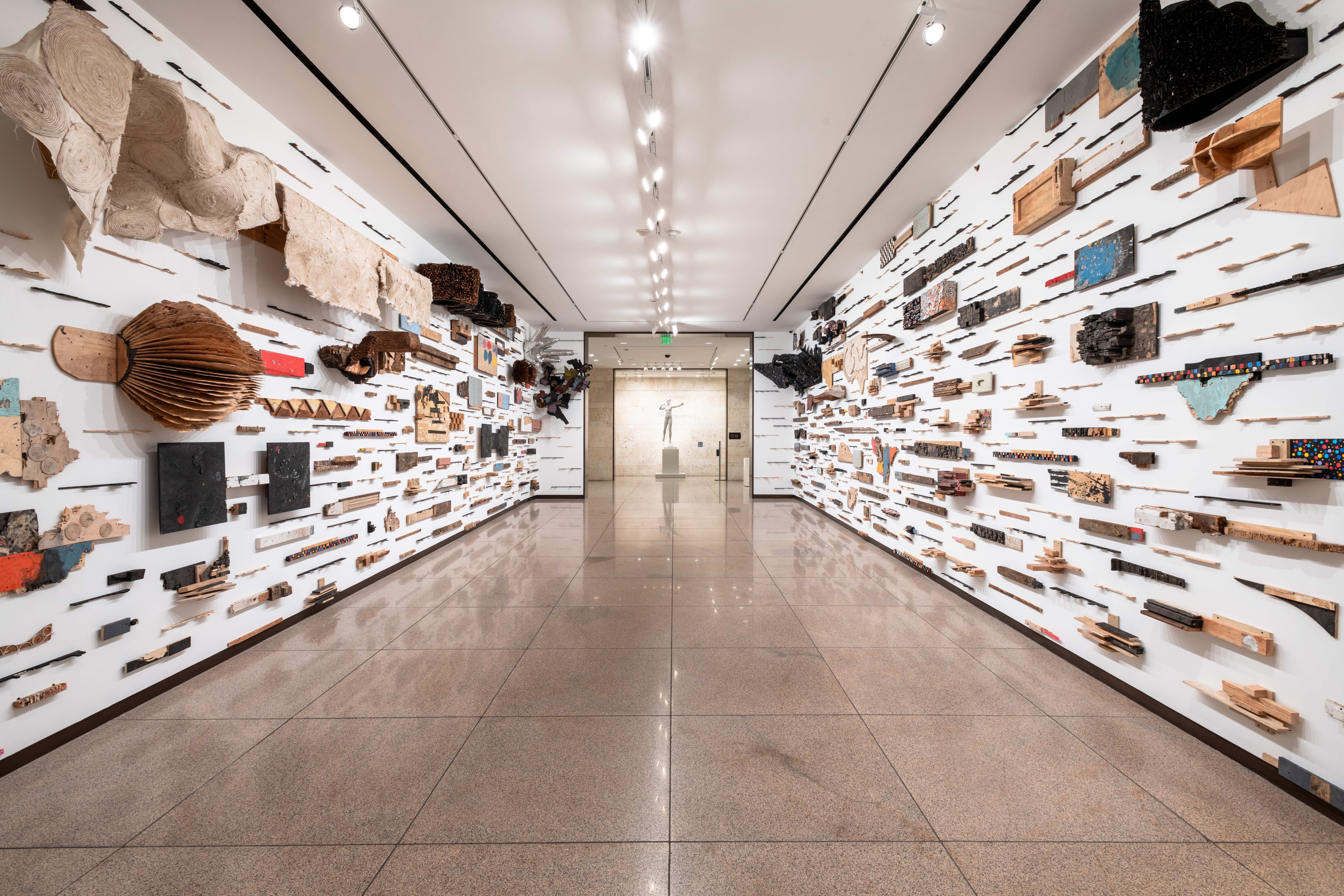
You’ve called the objects in your earlier work “planets” and “stars.” Like in Number 235T at the Carter Museum.
If I’m going to build a composition, I want to anchor that composition with planets. Then I build the stars into that. That cosmos, that larger galaxy, you know? All the things that are seemingly more expressive and larger, they go on first. I can orchestrate a group of people after those large things are planted. They can go in and start putting up the stars. I can use a laser pointer and I say, “Put that here.” But a lot of times they put the stars up where they like, when they’re brave enough. They just jump in.
What are some of these objects?
I call that one “fat man.”
“Fat man.”
It’s this big heavy thing made of wood and looks like Oliver Hardy.
I’ve seen this one in a lot of your work.
We call that “the dog.”
The dog above the fat man. And what’s underneath the fat man.
These are the short-hand names that we give in the studio. Like when I tell the guys, “Okay, we need to put the dog into the truck,” you know? “Put the fat man into the show.” So we know what we’re talking about. They have to be distinct to get a working name in the studio. I still own fat man. The dog has gone into different iterations too.
Why is it called the dog?
In the first iteration it had the shape of a dog. From that point on, whenever we do a piece, we call it the dog.
I wanted to end with a question about your studio. There’s an Art21 video of you in your studio in 2014. You’re sitting on a ladder in a way that you shouldn’t be sitting on a ladder. There’s an old TV playing a film in the background. You’re drilling, you’re cutting, you’re gluing. What does a day look like today in San Antonio?
I’m back and forth between Brooklyn and San Antonio. I love working, but the 20-hour days have caught up with me. I’m getting an operation on this wrist. A year ago I had an operation on this one. I’ve had my knees replaced. It’s all wear and tear. The physicality of 16 hours at the table saw—all these things add up and at some point your body starts to break. Now I’m trying not to go past 14 hours. A day in the studio is still about blood, sweat, and tears. I still want to make work, but I have to make it differently. I have to think more. Before, I had to literally break my body in order to get the answer. Now I’m a lot smarter. The level of commitment, the physical adjustments that I make are more strategic. I don’t sit on the ladder the way you saw me because I would fall off.
It’s not how you’re meant to sit on a ladder.
All my life I was perching on a ladder like that.
It reminds me of how you use materials–in ways that they’re not made for. Thinking about the theme of this issue, can you tell me about the TV in your studio?
That TV probably exists in every photo of the studio. People always draw their attention to it and make sure they get it along with all the other noise in the studio. That TV goes back to 1995. Every day we’re playing it. Its sister broke down a year ago. But this one is still going.
What’s playing?
I love the auteurs—Truffaut, Kubrick. But if I’m not playing my collection, it’s on Turner Classics. It’s on Turner Classics a lot.