
[drop-cap]
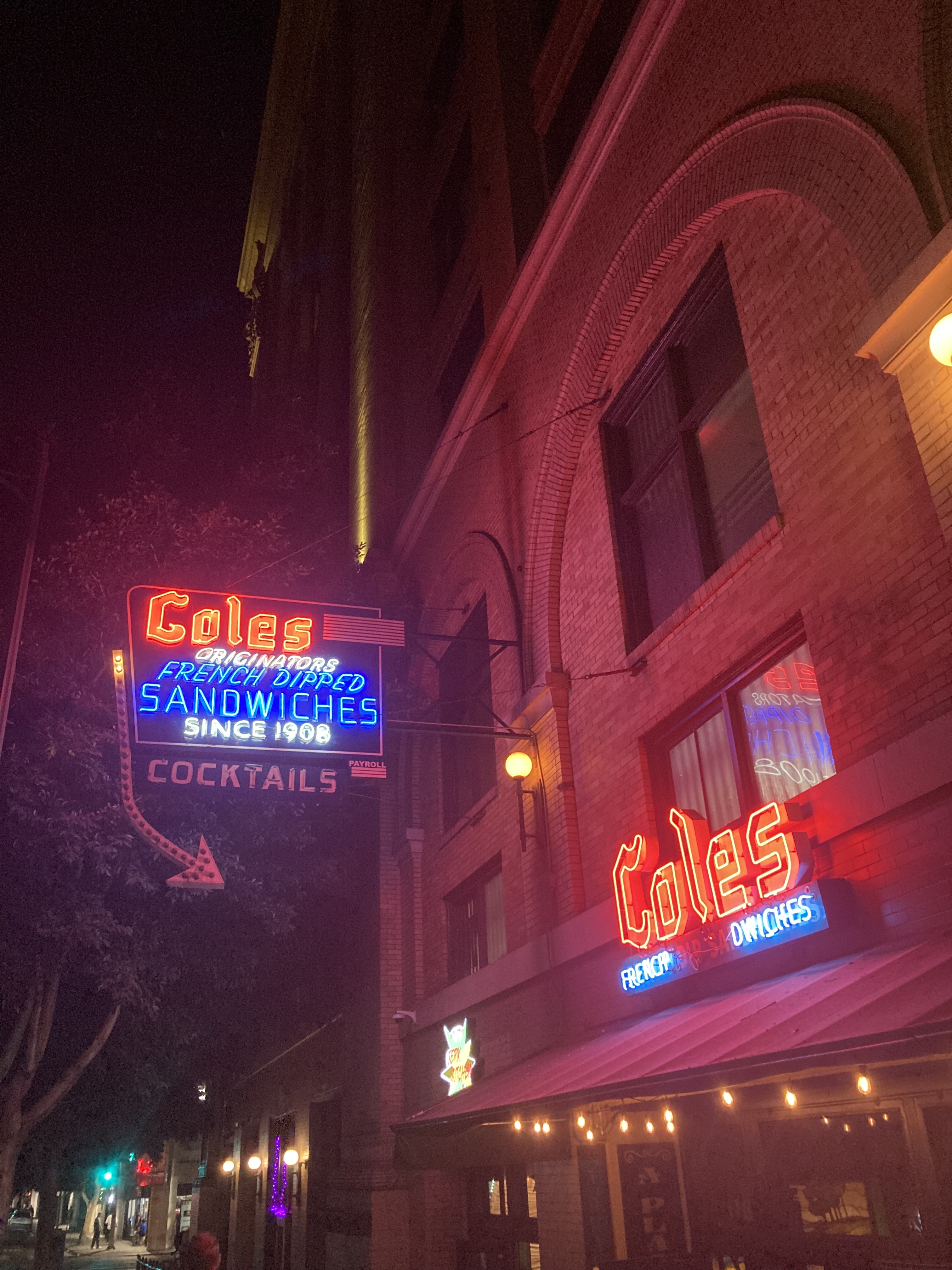
I grew up in Los Angeles in the 1990s and early 2000s. I left for the first time in 2008, a year which now sits on a precipice. When I began returning for regular visits around 2015, it was no longer the city of my memories—a place filled with the sun-faded colors of neon hamburger stands and corner stores; Googie gas stations left over from mid-century; the newsstands and paper racks at every major intersection; cluttered book, record, and electronics repair shops scattered about town; the decaying Red Car tracks that still bisected Santa Monica Blvd; and lush, bougainvillea-wrapped bungalow courts galore. Back then, there was a sense, however misguided, that the city beat to the rhythm of its residents and that it meant something almost tangible, if not quite effable, to be from Los Angeles.
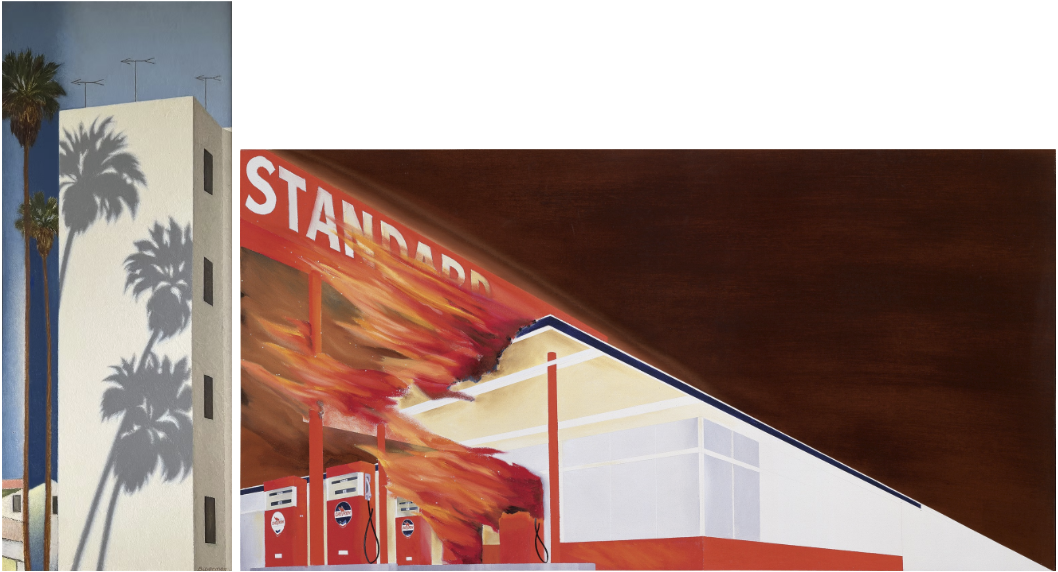
I was born in West Hollywood. Over time, my family moved steadily westward, settling on the south side of Beverly Hills. Childhood is a joyously unsubtle time: Signs, colors, seasons call out at you playfully with a sly wink, ever on the verge of unintelligibility. Children are your people and adults are caricatures of authority. In my daydreams, the city’s neighborhoods were stark, composed, devoid of those I did not, or cared not to, understand. The palms commanded less attention than their shadows. Consciously unaware of it, I inhabited a world of Edward Biberman’s making.
Time warps the child’s eggshell brain into the mind of a teenager. Puberty breeds the confusions of desire and value, and these blossom into articulations of rage and irony. Los Angeles was transforming in the first decade of the 21st century, but not as quickly as the world outside of it—war, the Internet, winds of change. My city called out to me aslant with vanishing points and big words, like mouths without a face, Ed Ruscha, a city—a world—burning aimlessly like a Standard Oil station.
Childhood and adolescence. Los Angeles, represented by clean lines and a crisp palette; paradoxical notions of deception and alienation. Nothing new there. But think harder, go deeper, to the dingbat on Lexington and Curson, brown doors; the neighbor who cut your hair in front of his unit with a cigarette hanging from his lip; the street hockey games your brother played with the boys from the neighborhood, kids whose grandparents lived above or across the hall from them speaking ancient-sounding languages; later, on Lasky Drive in Spanish Colonial Revival white and terra cotta tile, the old New Yorkers who invited you and your family downstairs for Passover Seder, whose sons ran a small business out of one of the garages out back. Over time, pieces of these images chip away but the light and the lines do not.
Back in 2015, my mother was living with her partner off Hazeltine Avenue, between Sherman Oaks and Van Nuys. We’d finally ended up in the Valley, I joked to her, L.A. had no use for us any longer. But it was in this house, a traditional Valley two-story with three bedrooms upstairs, a two-car garage, and a wet bar in the den with 1970s sunburst glassware that I finally had access to a kidney-shaped pool. Every morning, I’d walk through the den and out the screen door to the concrete backyard. I’d set my towel—some days canary, some days periwinkle, or some other long-faded color combination—on a slightly dusty gray pool chair and dive in. After a handful of laps, I’d catch my breath at the pool’s edge, and admire the juniper trees along Hatteras, the neighbor’s large magnolia, and a row of skinny palms further back, aslant with Pisan grace against the blue, effortlessly clear sky.
I did not know it then because I always took my life in Southern California—the sights and intonations—for granted, but in certain unmistakable ways the aesthetic had matured into a David Hockney painting. I was usually alone out there, and, as a young man in my mid-twenties, I spent a good chunk of time contemplating what I felt was an intimacy missing from my life. The erotic frankness with which Hockney’s paintings presented homosexuality was instrumental to his artistic identity, but it wasn’t the only—or necessarily key—component. His L.A. paintings from the mid-1960s to the mid-70s weren’t so much erotic (though many certainly were) as they were intimate, not only in subject matter, but in a sense of private longing and, too, a sense of loss. Perhaps what speaks loudest in the “Splash” series (1966-67), arguably his most famous paintings, is what’s absent. “Art,” Hockney told Lawrence Weschler in 1984, “is about correspondences—making connections with the world and to each other. It’s about love in that sense.”
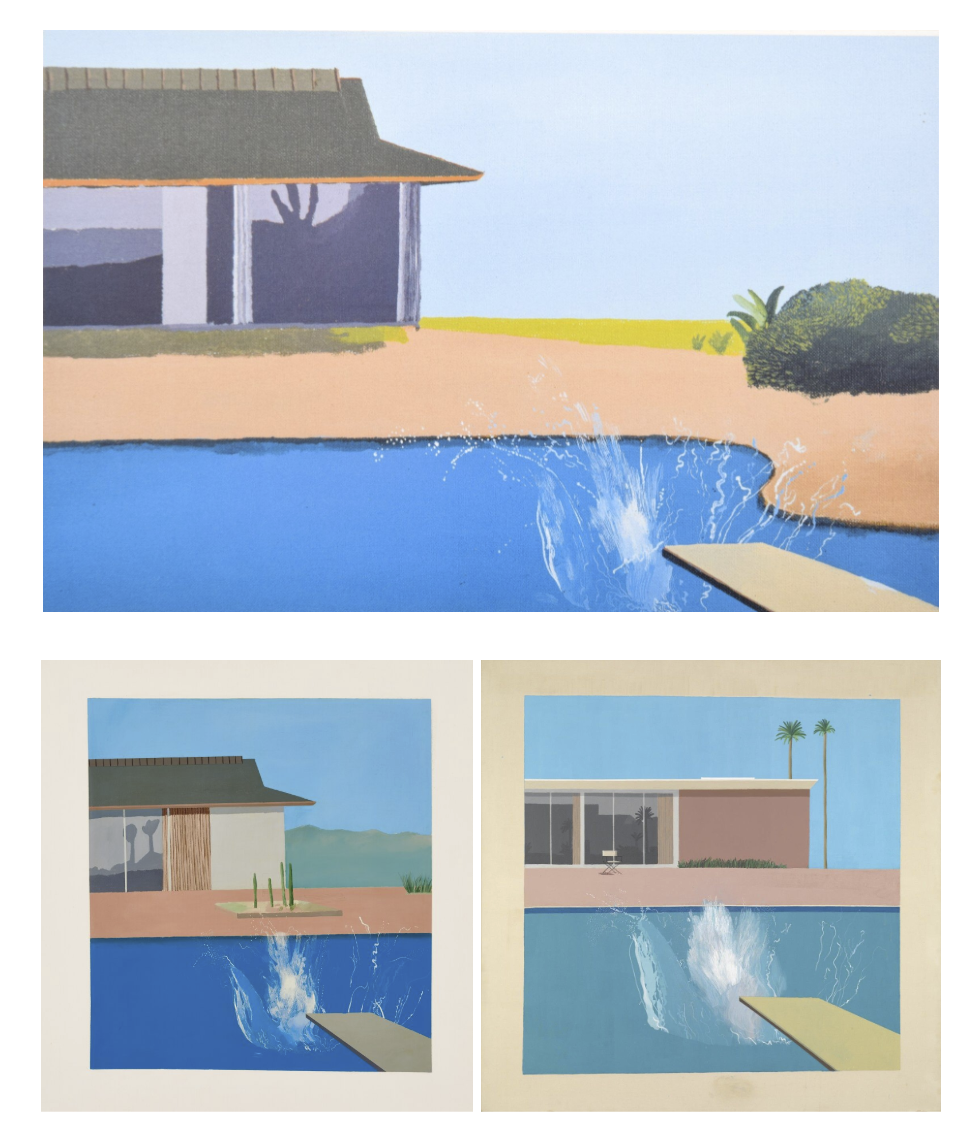
Clearly, a particular aesthetic component to Los Angeles, or at least the one that shaped the way I saw it, was forged by a painter from Yorkshire long before I was born. What’s instrumental to Hockney’s conception of art—the act of correspondence—is the intimacy one feels when looking at a work that possesses a tone you instantly recognize, that communicates a feeling you’ve always known. Hockney’s first batch of L.A. paintings, while communicating something to all viewers across time, communicated something particular to Angelenos. For me, I recognized a palette and a compositional quality that defined the one place I purported to know better than any other, and yet hadn’t managed to articulate for myself. This shock of recognition was very alluring. Sexual preferences aside, to stand at the edge of paradise and feel despair is a bizarrely commonplace occurrence in Los Angeles. And yet, just like L.A., Hockney’s work always bends toward the light.
This lightness to the works of David Hockney, while at first glance reminiscent sometimes of Raoul Dufy, at other times of the saturation of the Fauvists, owes a debt to the Renaissance frescoes of Fra Angelico and Piero della Francesca, influences both. His brightness and playful use of color subjected him to accusations of insubstantiality or flippancy, but his brilliance and rigor as a draughtsman suggest otherwise. In this way, he and Los Angeles were a perfect match: How hard you looked determined what you saw. But color is light and light is life.
Somehow, in his broad, colorful strokes and bold perspectives, Hockney managed to communicate a bit of the brightness of life—its very levity—a sense one sometimes gets while driving along Mulholland Highway, for example, with the right music on the radio, pointing toward the sea and the setting sun. In many of his works, the lightness of Hockney’s touch communicates his wry sensibility, a philosophy of the amused—“I’ve always thought life was basically absurd,” he said in a television interview, “… however rotten you might think the world is, it is always possible that there is something quite good about it.” His optimistic candor, rather Southern Californian, is relatively unique among the majors of art history.
In this way, Hockney and Los Angeles were a perfect match: How hard you looked determined what you saw.
What does the death of David Hockney mean? For many, his California works, with their facades of a dated glamor, no longer speak to those for whom, in short, Eden has fallen—or never even was. But when you consider the man in conjunction with his work—with his emphasis on resisting conformity, on embracing life as a riposte to the fear of death, on filling places and spaces with the clutter of human spirit, or even the sense of freedom, creative and personal, he seemed to luxuriate in—the death of David Hockney is a remarkable loss. Back in the mid-to-late 20-teens, when I often lay by the pool that belonged neither to me nor my mother, I still felt rich, in the Hockney sense—the sense that I felt I could do what I wanted. Yet, I still mourned the parts of L.A. that seemed to disappear with every visit, like faded postcards blown out a window, one-by-one.
My life in Los Angeles in the first half of this decade was a further series of losses. It isn’t simply that the contours of the city have changed, or even the fabric of its residents—Angelenos have always been from someplace else—it’s the sense that a secret garden of sorts, once cultivated and harvested in an act of imperfect congress, has finally been overrun by a maleficent carelessness, a parasitic greed suffocating both the intimacy and spaciousness out of it. With the death of David Hockney comes the reminder of a cycle closing. Contrasted by artists like Hockney, today’s fascination with data and capital is exposed as incredibly morbid, a form of vivisection, Thanatos at its most depraved.
If you drive out Highway 1 to the farthest reaches of Malibu, or position yourself along Mulholland at just the right vantage point, you can still see what drew everyone out there in the first place, you can still see the play of light on water, hear the gentle sweep of wind along sagebrush, chaparral, and juniper. Should we choose to slow down and really look, maybe we can find glimpses of what it is we’re all looking for—enough. Perhaps a touch, a faint connection, something to remind us that we don’t need so much, like two bored children sitting on the brown railing of a balcony in a peach-colored dingbat on Lexington Avenue, who find they’re no longer bored because they’re together, simply looking out at the light as it drapes over the almost exotic treetops and the rooftops out to the horizon someplace.