
Glendower. I can call spirits from the vasty deep.
Hotspur. Why, so can I, or so can any man; but will they come when you do call for them?
—Shakespeare, Henry IV, Part I
[drop-cap]
Surprised by an epiphany, I was pulling over to park on a crowded avenue in Northside, Berkeley when I heard the voices of the dead. Out of the blue, and speaking from the car radio, William Butler Yeats introduced himself to an audience (now too long dead) and recited “The Lake Isle of Innisfree.” Yeats was followed by Gertrude Stein, Ezra Pound, William Carlos Williams, John Masefield, a medley. How “cultivated” were their voices, with graces like trilled r’s, unheard in American English for generations! In their uniform gentility the dead cast a spell on the passing scene—here, on an ordinary afternoon, on a block where the University of California campus reaches across the street, were the young in one another’s arms, as in Yeats’s “Sailing to Byzantium,” lordly youths riding skateboards or scooters, who might have sprung from Irish or Persian or Indian mythology, law students who looked like the young Trotsky, engineering majors out of a pre-Raphaelite painting. The spell was broken when the host, a local poet whose living voice I recognized, came on air to name the vanished company he had summoned.1
A good deal of academic life consists, or used to consist, of listening to the dead, as they lived on in print, or plays, or “audiovisual” form, or, less often, phonograph records. Within living memory those séances took something of the form they did for Machiavelli, as told in the famous letter to his friend in Rome, Francisco Vettori, December 10, 1513:
When evening has come, I return to my house and go into my study. At the door I take off my clothes of the day, covered with mud and mire, and I put on my regal and courtly garments; and decently reclothed, I enter the ancient courts of ancient men, where, received by them lovingly, I feed on the food that alone is mine and that I was born for. There I am not ashamed to speak with them and to ask them the reason for their actions; and they in their humanity reply to me.
Almost five hundred years later, the literary historian Stephen Greenblatt, in his early New Historicist phase, confided to readers his “desire to speak to the dead”: “It was true that I could hear only my own voice, but my voice was the voice of the dead, for the dead had contrived to leave textual traces of themselves, and these traces make themselves heard in the voices of the living.” W. H. Auden put it more succinctly in his elegy for Yeats in 1939: “The words of a dead man / Are modified in the guts of the living.”
In antiquity it required a journey to the underworld to hear the dead speak. In The Epic of Gilgamesh, which has been called “the oldest story in the world,” the semi-divine king’s elective brother, the wild man Enkidu, possessed by thoughts of death, makes a visit in a dream to the “house where people sit in darkness.” The earliest texts which comprise the “epic” were preserved in cuneiform about 2100 BCE, a thousand years before Homer sang of Odysseus’ visit to the underworld, where he speaks with Agamemnon and Achilles. A thousand years later, Aeneas makes his descent in Virgil’s epic, followed 1200 years later by Dante, who is guided by Virgil’s shade in The Inferno. In the mid-20th century, the chthonic journey is resumed by Allen Ginsberg in “A Supermarket in California,” in which the young poet imagines a walk down solitary nighttime streets with Walt Whitman’s ghost for company:
Ah, dear father, graybeard, lonely old cottage-teacher, what America did you have when Charon quit poling his ferry and you got out on a smoking bank and stood watching the boat disappear on the black waters of Lethe?
The poem is datelined “Berkeley 1955,” the annus mirabilis of the Beats. Ginsberg was living in a “little rose-covered cottage” in the backyard of 1624 Milvia Street, putting the finishing touches to Howl, which he would debut at the legendary Six Gallery reading on October 7, in San Francisco. By now a poet had ways other than the figurative to listen to the dead, if not to be heard by them. In The Dharma Bums (1958), Jack Kerouac, Ginsberg’s roommate that fall, remembers “one main room, covered with pillows and floor mats of straw and mattresses to sleep on, and books, books, hundreds of books everything from Catullus to Pound to Blyth to albums of Bach and Beethoven (and even one swinging Ella Fitzgerald album with Clark Terry, very interesting on trumpet) and a good three-speed Webcor phonograph that played loud enough to blast the roof off . . .”
In the culturally avid Postwar the spoken word was enjoying a vogue, in the flesh and on the phonograph. T. S. Eliot, whose collected poems Ginsberg read aloud to himself in his cottage, had recorded most of his poems in 1946. At an event at the Poetry Center at the 92nd Street Y in New York City in 1950 he wondered why people would come out on a rainy night to hear a poet read when they could listen to a recording at home “or some other comfortable place.” A few years later, Eliot performed for a stadium audience of 18,000 at the University of Minnesota at Minneapolis, a rock star turnout before the Beatles or Bob Dylan. Ezra Pound was another of the living poets whose voices had been recorded by the Harvard Vocarium label, which pioneered in poetry readings; Ginsberg might have listened to them in the University Library to which he had access as an enrolled graduate student. His own readings were soon to be recorded, and, as he became a public figure, he was rarely parted from a microphone.
In his occult novel Flicker (1991), Theodore Roszak, the author of The Making of a Counter Culture (1969), proposes that we can imagine Greek or Roman, even Babylonian movies—but they would have been silent movies. The possibility of literally hearing the words once spoken or sung by those who have died, as opposed to engaging them figuratively in conversation like Machiavelli or Stephen Greenblatt, via books or performances, was broached in Europe’s Renaissance in the form of the “frozen words” in the fourth book of Rabelais’ Pantagruel.
Voyaging on the high seas, the titular giant and his traveling companions are startled to hear peoples’ voices in the air though no one can be seen. After some preliminary philosophizing, they are setting out to solve the mystery when the ship’s pilot offers reassurance:
We are on the borders, here, of the Glacial Sea, on which, at the beginning of last winter, the great and awful battle between the Arimaspians and the Nephelibates was fought. At that time the cries of men and women froze upon the air, along with the clashing of armor, the shock of battle-harness and of barbs, the neighing of horses and all the other uproar of the fight. But now that the rigor of winter is past and serene and temperate weather has come once more, these sounds melt and are capable of being heard.
Pantagruel scoops up some handfuls of the frozen words, which resemble striped candies of different colors. “We saw there throaty words, quartz-green words, azure words, sable-colored words, golden words, which, when they had been heated a little between our hands, melted away like snow; and we could really hear them, but we could not understand them, for they were in a barbarous tongue.”
Rabelais’s Jazz Age translator Samuel Putnam wondered if he was “dreaming of our radio,” before deciding, unimaginatively, “it was simple Platonism, which was then very much in vogue” in 17th-century France. But it was not ideas that had been caught in ice but rather shrieks and battle cries; and it was phonography that Rabelais was foreseeing, not radio, although, per Marshall McLuhan, the older medium was destined to be the content of the younger.
Historians of media note that Thomas Alva Edison bellowed “Hullo!” into a mouthpiece in early summer 1877 at his laboratory in New Jersey, which registered, barely, on a moving strip of paraffin. By December he and an assistant had built an apparatus capable of recording a recitation of “Mary Had a Little Lamb.” As the German media theorist Friedrich A. Kittler writes, “The exhausted genius, in whose phrase genius is 1 percent inspiration and 99 percent perspiration, slumped back. Mechanical sound recording had been invented. ‘Speech had become, as it were, immortal.’”
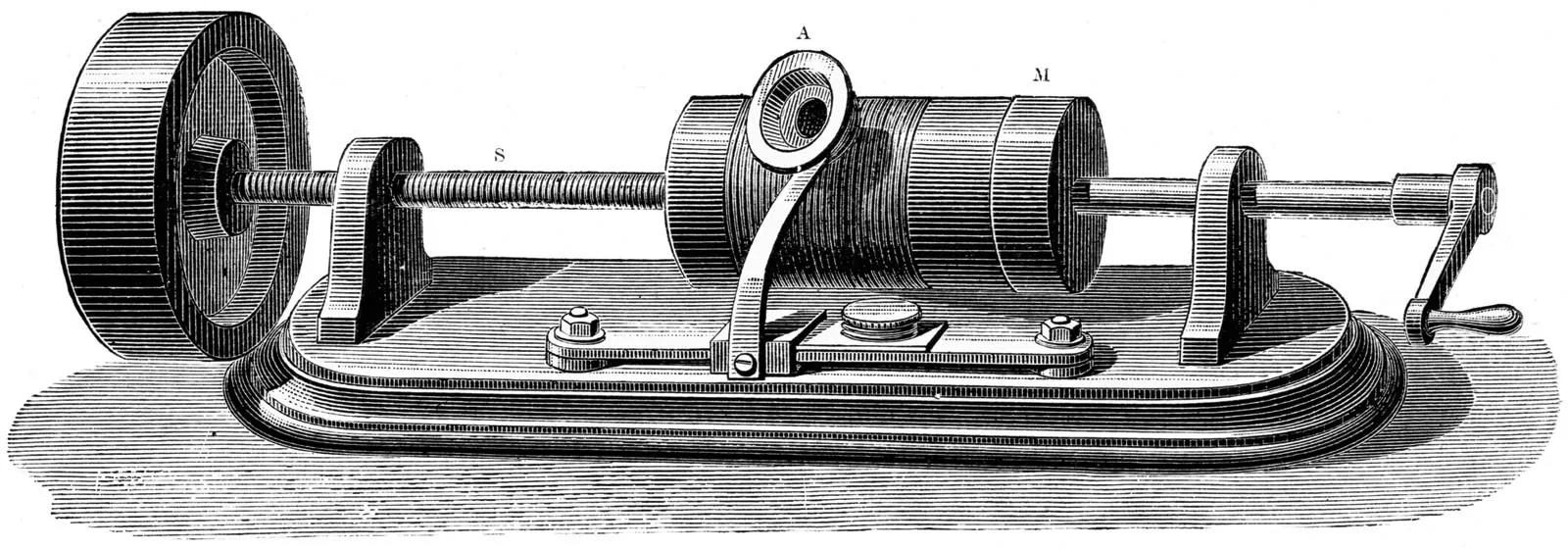
Its development had proceeded on two paths: prosaically and commercially but not without eerie intimations, in America, in Edison’s laboratory; and in France where it was conceived in cultural proximity with Symbolist poetry and Wagnerian opera. Eight months before “Mary Had a Little Lamb,” Charles Cros, described by Kittler as a “Parisian writer, bohemian, inventor, and absinthe drinker,” had deposited a sealed envelope with the Academy of Sciences. It contained an essay on the “Procedure for Recording and Reproduction of Phenomena of Acoustic Perception.” Cros, as he conceded, had a program but had not produced a mechanism, lacking the money; however, the one he conceived but did not build operated as Edison’s phonograph did, using the vibration of a diaphragm to inscribe on a rotating disk.2 Learning that Edison had actually done the thing, Cros wrote a short poem, “Inscription,” to celebrate his unrealized appliance (an automatic telephone and color photography were others):
Like the faces in cameos,
I wanted beloved voices
To be a fortune one keeps forever,
And which can repeat the musical
Dream of the too short hour;
Time would flee, I subdue it.
Such thoughts occurred to the editors of the weekly Scientific American, to whom Edison had introduced his “Talking Phonograph” early in December 1877, in advance of applying for a patent on Christmas Eve. As introduced in the December 22 issue, it sounds uncannily like a chatbot, or at least the premonition of a chatbot.
“Mr. Thomas Edison recently came into this office, placed a little machine on our desk, turned a crank, and the machine inquired into our health, asked how we liked the phonograph, informed us that it was very well, and bid us a cordial good night.” The Scientific American continues, “These remarks were not only perfectly audible to ourselves, but to a dozen or more persons gathered around”: failing to note, as it belatedly did a decade later, that the awed auditors could only understand what came out of Edison’s “simple little contrivance” because they had heard him bellowing the words into it to be reproduced. Details, details! Even in its earliest iteration, the phonograph would lay the basis for Edison’s enduring worldwide fame, pausing only, as Morris notes, for the time it took to register its uncanniness.
“We have already pointed out the startling possibility of the voices of the dead being reheard through this device,” Scientific American declared, “and there is no doubt but that its capabilities are fully equal to other results just as astonishing.” Among these were the possibility of immortalizing a diva whose performances would otherwise inevitably fade away. In a concrete way was vindicated the ancient poet’s boast, going back to Horace and Ovid, and revivified by Shakespeare in Sonnet 55:
Not marble, nor the gilded monuments
Of princes, shall outlive this powerful rhyme;
But you shall shine more bright in these contents
Than unswept stone, besmeared with sluttish time.
But while the poets had insisted on their winged words’ self-sufficient immortality, Cros and Edison premised their conquest of time on material means—for Edison, tinfoil, later wax, later shellac.
“Professional and popular plaudits were inhibited at first by the almost occult nature of his invention,” according to Morris, but within a few months Edison was enveloped in a Byronic blaze of publicity that spread from New York westward to San Francisco, eastward to London and St. Petersburg. In an article for the North American Review, June 1878, Edison helpfully listed some possible uses for his invention, of which the first five were:
1. Letter and writing and all kinds of dictation without the aid of a stenographer.
2. Phonographic records, which will speak to blind people without effort on their part.
3. The teaching of elocution.
4. Reproduction of music.
5. The “Family Record”—a registry of sayings, reminiscences, etc. by members of a family in their own voices, and the last words of dying persons.
What consolation and joy! Or not. Number 6, “Music boxes and toys,” was actually the first use to be realized. Ready to move on to other ventures, Edison licensed the phonograph to the Edison Speaking Phonograph Company, appointing as general agent a long-time colleague, Edward Johnson. Johnson, who had shared poverty and obscurity with Edison in their earlier days (but would not share fame and fortune in later days) put on a traveling show of “Recitations, Conversations, Cornet Solos, Animal Mimicry, Laughter, Coughing, &c,” for paying audiences, while “Edison made side deals with the marketing of talking toys and clocks,” taking a 20 percent royalty without providing any mechanical assistance. Thus was launched the talking doll which would become a periodic holiday fad and horror-movie staple.3 In this connection we are told that, before returning to the more serious business of telephony, Edison made a preliminary reconnoiter of the technical advances and improvements he envisioned for the phonograph, including disk records, waxed cylinders in place of tinfoil, “electromagnetic recording and reproduction; mass duplication by electroplating and the use of printing presses.” All of this was by way of applying for two British patent applications, something he neglected to do in America for the same schemes, “and thereby committed himself to years of bitter later litigation.”
While he was inventing the light-bulb, others actually made the improvements Edison had foreseen in patent applications. The first waxed cylinders, with a floating stylus that incised rather than indented, came out of the laboratory of Alexander Graham Bell. Per Edmund Morris: “But the phonograph was involved in many misconceptions, as one of its early names—gramophone—implies. It was conceived as a form of auditory writing—gramma-letters. The idea of it as a ‘talking machine’ was especially popular.”
We are told that Edison’s progress on phonography was held back for several years by the notion that it was a repository for data from the telephone, which it enabled to “provide invaluable records, instead of being the recipient of momentary and fleeting communications,” as he wrote disparagingly in his article for the North American Review. Bell had labored under a similar misunderstanding of invention, always imagining that a telephone call would culminate in a stenographer transcribing a message. Or as Morris puts it, “It was beyond even Bell’s imagination that people might one day use his invention just to chat.” The telephone was a business appliance, like the cash register, and its inventor would never allow one in his home.
In summer 1889 Edison spent five weeks in Paris for the World Fair (Exposition Universel), where his company’s exhibition was a main attraction. Feted at elaborate banquets, chased by reporters, stared at by crowds, apostrophized by Victor Hugo (his favorite poet), Edison was received as the greatest celebrity of all who had come to town for the fair; and the basis of this acclaim was, of course, the incandescent light-bulb and the phonograph, son et lumière. Sadly, his visit coincided with the death of his most fervent French literary admirer, Auguste Villiers de l’Isle-Adam, the Symbolist poet, dramatist, and fiction writer. In English Villiers is best known for one line in a long dramatic poem, Axel (1890): “As for living—our servants will do that for us,” said by the hero, who is proposing a suicide pact to his lover; and for Edmund Wilson using its setting as the title of his 1931 study of modernism, Axel’s Castle. A long obsession with Edison had culminated in L’Eve future (The Eve of the Future), in which Edison, unable to record the voice of God, turns to the easier task of creating a female android—the word already existed in English and French—a mechanical creature, singing and dancing, who somehow would also be able to reproduce. A columnist in Le Figaro regretted that Edison, “who resembles Napoleon and is deaf like Beethoven,” had certainly never heard of Villiers, but in later years he did, and subscribed to a fund to raise an allegorical statue in honor of his admirer.
Once persuaded that the phonograph had a place in the home, Edison set about perfecting the new-fangled waxed cylinder. After cruder experiments he arrived at an alchemical recipe, “as secret as Babbage’s solution to the Vigenère cipher,” consisting of burgundy wine, frankincense (but no myrrh), and beeswax, with dashes of a rosin and olive oil, the mixture heated solid and poured into molds. Possessed of “this dark red medium” (Morris, again), Edison began a decades-long pursuit of celebrity performers and endorsers, recording “such celebrities as Mark Twain, William E. Gladstone, Lord Alfred Tennyson, Florence Nightingale, Sir Arthur Sullivan, Prince Napoleon, Otto von Bismarck, and the aged Count Helmuth von Moltke,” born 1800.
Most of this acoustical treasure hoard, including a cylinder of Mark Twain telling jokes, was lost in a devastating chemical fire at Edison’s laboratory complex on December 9, 1914. (“Yes, Maxwell,” the rapt wizard told a shaken employee, “a big fortune has gone up in flames tonight, but isn’t it a beautiful sight?”) In the end everything depends on the materiality of the medium. Edison clung stubbornly to the wax cylinder even as it passed from novelty to anachronism; perfecting a device that could be faithful both to the human voice and the symphony orchestra was his most enduring pursuit. When he turned to developing the movie camera, he said his aim was to do “for the eye what the phonograph does for the ear.”

Symbolically, the phonograph’s defining image in the early decades of the 20th century was, as it long remained in popular culture, His Master’s Voice—a painting of a white dog peering inquisitively into the bellows of a phonograph. Originally, it was a cylinder phonograph, but when the painter Francis Barraud, the brother of the late dog’s late human companion, offered it for sale to the Edison-Bell Company, its London representative replied, “Dogs don’t listen to phonographs.” The owner and manager of the rival Gramophone Company was more imaginative, and bought the painting on the condition the soon-to-be obsolete cylinder was replaced by a disk. Rebranded as the Victor Talking Machine Company, the firm was acquired in 1929 by RCA (Radio Corporation of America), the highest-flying tech stock of the time. The Victrola phonograph player, not Edison’s cylinders or his later Diamond Disk, became virtually synonymous with the medium. So it appears in “The Form of the Phonograph Record,” an essay published in German by T. W. Adorno in 1934:
One does not want to accord it any form other than the one it itself exhibits: a black pane made of a composite mass, which these days no longer has its honest name any more than automobile fuel is called benzene: fragile, like tablets, with a circular label in the middle that still looks most authentic when adorned with the prewar terrier hearkening to his master’s voice; at the very center, a little hole so narrow that one has to redrill it wider so that the record can be laid upon the platter.
In this form the phonograph record had enlivened and helped define the Jazz Age, especially after its fated rendezvous with radio. McLuhan, in Understanding Media (1964): “It was radio that finally injected a full electric charge into the world of the phonograph. The radio receiver of 1924 was already superior in sound quality, and soon began to depress the phonograph and record business. Eventually, radio restored the record business by extending popular taste in the direction of the classics.” The car radio, most popularly the Motorola, introduced in 1930, made recorded sound mobile, literally and figuratively putting it on the road; the transistor radio, developed during the war and introduced commercially in the mid-l950s, made it portable.
In its first decade as a broadcast medium, radio was, literally, of the moment. In Hemingway’s story “The Gambler, The Nun, and the Radio” (1933), the author’s stand-in, Mr. Frazer, laid up in a hospital in Hailey, Montana, after a horseback accident, becomes involved in the slow dying of a handsome young gambler, who refuses to say who shot him, meanwhile fending off nada with the night-time broadcasts on the radio. The reception improves after dark,
and when one station stopped you could go farther west and pick up another. The last one you could get was Seattle, Washington, and due to the difference in time, when they signed off at four o’clock in the morning it was five o’clock in the morning in the hospital; and at six o’clock you could get the morning revelers in Minneapolis. That was on account of the difference in time, too, and Mr. Frazer used to like to think of the morning revellers arriving at the studio and picture how they would look getting off a street-car before daylight in the morning carrying their instruments. Maybe that was wrong and they kept their instruments where they revelled, but he always pictured them with their instruments.
Orson Welles’ Mercury Theater dramatization of H.G. Wells’s “The War of the Worlds,” broadcast on Halloween, 1938, caused a panic (at least among the panicky) because listeners like Mr. Frazer assumed that the bulletins about the alien invasion from Mars were “live,” not pre-recorded. Meanwhile, the extension of popular taste into classical music that McLuhan speaks of was being advanced by the upward-bound and culturally aspiring, writers and artists included. In his memoir Timebends (1995), Arthur Miller recalls a fellow playwright farther up the greasy pole than himself in 1939, and his conspicuous media consumption:
[Clifford] Odets, one heard, had moved into One Fifth Avenue, one of the most elegant apartment houses in New York, and owned hundreds of records. I could never roam the streets of the Village without glancing up at that elegant apartment house, overlooking Washington Square and thinking of him with shelf upon shelf of classical music at his fingertips, and probably beautiful actresses stretched out on one of his numerous couches, and him with his shock of wavy hair staring moodily down at the city that waited for the clacking of his typewriter for scenes that would mesmerize and save.
Most of these would have been 78 RPM discs, which remained the standard format for a half-century; a principal ingredient was shellac, an insect secretion sourced in India and southeast Asia, which became scarce during the war, speeding the adoption of vinyl. Midway in this history the popular musical landscape was shaken by the repeal of Prohibition at the beginning of the New Deal. In The History of Jazz (1997) Ted Goia comments, “The end of Prohibition in 1933 transformed many speakeasies into legitimate nightclubs, but the change was hardly a positive one for most jazz players. Not only alcohol but the whole ethos and ambiance of jazz culture were demystified in the process. Both could now be easily consumed at home: alcohol legally purchased at the liquor store, jazz carried into the household over the airwaves.” It was in fact the demystification that made jazz music for a time popular music.4
Within a few years phonograph records would provide a dissident sound track in the cellar bars of occupied Paris known as discotheques. It was the Existentialist hour (Camus’s The Stranger was published in 1942, Sartre’s Being and Nothingness in 1943), and never, Sartre would maintain, were they freer, in an Existentialist sense. The “mandarins,” as Simone de Beauvoir called their crowd, older than the one that frequented the discotheques, drank their nightly whisky in statelier places like the Pont-Royal. But just as music played by the certifiably living was reassuring to the fictional Mr. Frazer, records were part of the historic resistance, neither more “authentic” to experience than the other.
McLuhan, resuming the story: “The real break [in technology] came with the availability of the tape recorder. This meant the end of the incision recording and its attendant noise. In 1949 the era of electric hi-fi was another rescuer of the phonographic business.” The “break” came about when American troops found themselves in possession of advanced German phonographic and radio technology, as Europe was liberated in 1944-45. Quoting Kittler, who defers to Pynchon: “The world-war audiotape inaugurated the musical-acoustic present. Beyond storage and transmission, gramophone and radio, it created empires of simulation.”
As an artifact of Cold War consumer culture, an object of desire and in some cultural precincts fanatical connoisseurship, high-fidelity evolved through stereophony to quadrophony, which proved, commercially, a bridge too far. Far into the 20th century none of these developments contradicted Adorno.
Nowhere does there arise anything that resembles a form specific to the phonograph record—in the way that one was generated by photography in its early days. Just as the call for ‘radio-specific’ music remained necessarily empty and unfulfilled and gave rise to nothing better than some directions for instrumentation that turned out to be impracticable, so too there has never been any gramophone-specific music.
Only recently has the delivery of recorded music been etherealized by streaming, catching up with a process that began early in the 20th century. As Buckminster Fuller later wrote: “In World War I industry suddenly went from the visible to the invisible base, from the track to the trackless, from the wire to the wireless, from visible structuring to invisible structuring in alloys. . . . All the major advances since World War I have been in the infra and the ultrasensorial frequencies of the electromagnetic spectrum. All the important technical affairs of men today are invisible.”
Retracing this history, we find the phonograph player entering high modernist literature with T. S. Eliot’s The Waste Land (1922) and the typist’s passionless mechanical tryst with the “young man carbuncular” at the violet hour. Afterward,
When lovely woman stoops to folly and
Paces about her room again, alone,
She smooths her hair with automatic hand,
And puts a record on the gramophone.
Witness to all this is Tiresias, in Greek mythology the blind Theban seer who, in his lifetime, was both man and woman, and is consulted by Odysseus in the afterworld. In the notes to The Waste Land, Eliot explains: “Tiresias, although a mere spectator and not indeed a ‘character,’ is yet the most important personage in the poem, uniting all the rest… What Tiresias sees, in fact, is the substance of the poem”:
(And I Tiresias have foresuffered all
Enacted on this same divan or bed:
I who have sat by Thebes below the wall
And walked among the dead.)
Like the song the sirens sang, what record the typist played is not beyond conjecture; given Eliot’s dislike of jazz, it was, undoubtedly, jazz to fit the sordid moment. In Understanding Media, McLuhan says, “we should note that the earlier period of mechanical recording and sound production had one large factor in common with the silent picture. The early phonograph produced a brisk and raucous experience not unlike that of a Mack Sennett movie. But the undercurrent of mechanical music is strangely sad. It was the genius of Charles Chaplin to have captured for film this sagging quality of a deep blues, and to have overlaid it with jaunty jive.” Chaplin, who never spoke aloud, defined the soundscape of the Great War, in a way that recalled what Oscar Wilde said of Hamlet: “The world has become sad because a puppet was once melancholy.” The birth of the blues was not recorded by phonography, but, as in Fitzgerald’s stories, all the young men were sad because of the blues they heard on phonograph records.
Though historically phonography was the later and, as it struck contemporaries, more eerie development, it has less often been considered as an art; there is nothing in its literature to compare with Susan Sontag’s On Photography (1977) or Roland Barthes’ Camera Lucida (1980) in the field of criticism. Phonography’s place in the world—perhaps one should say, its version of the world—has historically developed in convergence, or contrast with photography. Both are located in a world of illusion, or rather a world based on illusion, which is another thing. As Adorno enigmatically writes, “If the productive force of music has expired in the phonograph record, if the latter have not produced a form through their technology, they instead transform the recent sound of old feelings into an archaic text of knowledge.” The well of the past is very deep.
Susan Sontag, reporting from 1977: Unlike written descriptions or paintings, “Photographed images do not seem to be statements about the world so much as pieces of it, miniatures of reality that anyone can make or acquire.” As parts of the “image-world,” their emotional appeal, or “charge,” as she calls it, degrades over time, eventually casting a melancholy spell. “All photographs are memento mori.” She continues:
A photograph of 1900 that was affecting then because of its subject would, today, be more likely to move us because it is a photograph taken in 1900. The particular qualities and intentions of photographs tend to be swallowed up in the generalized pathos of times past. Aesthetic distance seems built into the very experience of looking, if not right away, then certainly with the passage of time. Time eventually positions most photographs, even the most amateurish, at the level of art.
The contrast with a phonographic record or any other industrial reproduction of sound could not be more telling. If photographs are a constant reminder that this, too, shall pass, reminding us of people and places in their eventual perishing, the phonograph’s sound defies time and wakens the dead; paradoxically, it is the photograph that enables us to hear Wordsworth’s “still, sad music of humanity,” but it is the recording of the voice that bids defiance to time. A photograph of a vanished crowd inevitably leads to the thought that all these people are dead, or will die in time, dispersed once and for all, because the photograph is an emanation out of the past, an artifact, while the movie, in Andre Bazin’s handsome phrase, is a “mold of light.” But the recorded sound is not the past recaptured: it is the past. New techniques might enable us to discover lost depths, to achieve higher fidelity to original performances and intentions, as we can with painting, but by definition this cannot be done with photographs. A photograph can be understood too quickly, but that is another matter.
Kittler nostalgically recalls how the Beatles used an ancient trick—time axis reversal—on “Revolution 9,” on the White Album, “to whisper the secret of their global success to the tape freaks among their friends that Paul McCartney had been dead for a long time, replaced on album covers, stage, and in songs by a multimedia double.” In 2024 the Beatles, the living and the dead, appearing in youth, middle age, and after-life, were reconvened via AI for a performance of “Now and Then,” which won a Grammy.
Since 2022, Ted Goia has decried how music streaming lures the mass audience—not unwillingly—into the past. “The hottest area of investment in the music business,” he writes, “is old songs—with investment firms getting into bidding wars to buy publishing catalogs from aging rock and pop stars. The song catalogs in most demand are by musicians in their 70s and 80s (Bob Dylan, Paul Simon, Bruce Springsteen, etc.), if not already dead (David Bowie, James Brown, etc.),” a description which is unkind but factual. In the long run these catalogs, of which Bob Dylan’s might have been the most expensive, must become a diminishing asset, but in the present it’s more profitable to reprise the dead, or the venerable, than to promote the young, as it was when a music-store proprietor in Liverpool, Brian Epstein, propelled the Beatles into global fame.
How long can the dead speak to us, when their time slips farther and farther away from what Henry James called the “visitable past”? How sobering to reflect that it has been a quarter century since Dylan wrote and recorded “Things Have Changed” for Curtis Hanson’s movie adaptation of Wonder Boys, at that edge in time. In the lyrics Dylan showed an undiminished Eliotic gift for finding and appropriating what he needed for a commissioned song, plucking “sapphire-tinted skies” from Shelley’s “Lines Written Among the Euganean Hills” and “forty miles of bad road” from Duane Eddy, among the borrowings that Dylanologists have detected. In the lyrics and even more broadly in the video directed by Hanson, in which he interacts with the characters in the movie, Dylan does turns as a wizened, God-fearing desperado and a campy old vaudevillian, all while channeling blind Tiresias who has seen it all, down to the sexual transformations (“Gonna take dancing lessons to do the jitterbug rag / Ain’t no shortcuts, gonna dress in drag”). It is a long distance from the fresh-faced singer at the gates of Eden in 1965. But the one singer of songs doesn’t cancel the other. In a piazza anywhere on Earth that boasts a loudspeaker, or in the privacy of an earbud, or in a singalong in a car bouncing on a remote coastal road at night with Revolver on the tape-deck, one can listen to the voices of the dead in a medley with the living. In Auden’s elegy the death of the poet was kept from his poems, and the poet when he dies becomes his admirers. Forever young.
- The local poet was Jack Foley (1940-2025), who was also a literary historian and encyclopedic anthologist of California poetry. “Cover to Cover,” his radio program on KPFA, ran from 1988 until his death.
- In Edison (2019) Edmund Morris gives Cros a passing mention and a footnote: “On April 18, 1877, Cros, too poor to apply for a patent, filed a letter with the Academie describing his idea of a paleophone that would reproduce sound by combining the ‘photoautograph’ voice-sketching method of Scott de Martinville with duplicative photoengraving, an almost prohibitively difficult process. Cros never built a working model. Despite conspiratorial theories to the contrary, he and Edison do not appear to have been aware of each other before December 1877. Morris’s magnificent biography runs backwards from the world respectfully waiting for the 84-year-year inventor to die in 1931 to his birth in 1847, a virtuosic narrative resembling Scott Fitzgerald’s story “The Curious Case of Benjamin Button.”
- In later years Edison’s phonograph players were available for listening in storefront venues, where customers could go from one device to another for a minute’s entertainment. Proceeding from his model, his earliest movie venture, the Kinetescope, was a peepshow, a format the movie industry, including Edison, would abandon for the big screen, only for it to be revived many years later for pornography.
- 78s have never quite gone away, as told in the New York Times, November 1, 2025, in a story by Ken Micallef headlined “A Sacred Place Where 90 Year-Old Jazz Records Reign,” which begins, “At the Hot Club of New York, time bends to the rhythm of the past. Jazz from the 1910s through the ‘50s crackles to life, spun 78 RPM discs made of shellac. . . . It’s mono, not stereo, and the bandwidth is limited. But since 78s were recorded live without postproduction edits, every note carries the immediacy of a live performance.
Sources
Quotations from Rabelais's Pantagruel are from the selection translated by Samuel Putnam, first published in 1929, and reprinted in The Portable Rabelais (New York, 1946).
I found the quotation from Buckminster Fuller, long ago, in Susan Sontag’s essay“One Culture and the New Sensibility” (1965), collected in Against Interpretation(New York, 1966), where he is quoted at length. Theodor W. Adorno’s “The Form of thePhonograph Record” and Ted Gioia's commentary on old songs were accessed online;the latter appeared in “The Honest Broker” on Substack. Although it is not quoted, my understanding of phonography's origins was greatly enlarged by Renée Altergott’s dissertation “Phonographic Imagination: The Birth of Sound Recording and the FrenchColonial Empire,” Princeton University, 2022, a captivating and illuminating study. I am indebted to Stephanie Miller, the Reference and Digital Initiatives Librarian at theGraduate Theological Union Library for accessing it for me.
Other sources and further reading as follows:
Stephen Greenblatt, Shakespearean Negotiations: The Circulation of Social Energy in Renaissance England (Berkeley, 1988).
Arthur Miller, Timebends: A Life (New York, 1987).
Ted Goia, The History of Jazz (Oxford and New York, 1997).
Marshall McLuhan, Understanding Media: The Extensions of Man (New York, 1964).
Friedrich A. Kittler, Gramophone, Film, Typewriter, translated, with an introduction, by Geoffrey Winthrop-Young and Michael Wutz.
Susan Sontag, On Photography (New York, 1977).