.jpg)
[drop-cap]
During Hanukkah of 2023, just two months after the October 7 attacks, my wife and I were invited to a small gathering of friends who live near us in Jerusalem. Educated professionals who worked in law, medicine, tech, and academia, we sat in a room, feeling rather lost and, as far as I was concerned, also pretty dumb. We had no idea how the war would play out, what level of destruction would fall upon Gaza, or how deep and total the corruption in Israel would become. Some of the smartest people I know were literally lost for words—and hope.
But a statement by one of those people stuck with me after our gathering: as a modern state, Israel was rare in that its initial infrastructure was built by civil society rather than a military. Its first paramilitary force in Palestine, the Haganah, was founded in 1920, over thirty years after the establishment of its first agricultural settlement, Petah Tikva. I found out later that this person, an entrepreneur, had written on this topic in the Israeli press. He said that if we could revive “mission-oriented innovation,” as he called it—to train groups of people to focus on specific civic projects—we might re-establish core principles around which various groups and communities in Israel could reconstitute in ways that would break the cycle that led us to 2023.
I was struck by his clarity of mind—but also by what I felt was a kind of naïveté. The civil society that created the infrastructure for what later became the State of Israel was decentralized. Its very existence depended on the non-existence of the state. When the state was founded in 1948, civil society had to organize itself around a single leader, army, and economy. These institutions—the government, the military, the financial system—were, like every bureaucratic structure, riddled with ingrained corruption. The civil society that created the state’s infrastructure was, in essence, put into an oppositional role. From that moment, as a democratic state, leaders would have to navigate civil society for power. This continued, in one form or another, until the Netanyahu regime turned the democratic system against itself. By using technicalities to trigger repeated elections, while exploiting an unprecedented level of control during the coronavirus pandemic, the ruling party managed to undermine the very same institutions that the founding civil society had worked to establish. The idea that we could agree anew on founding principles for the state seemed too far from the place where this society as a whole had arrived. Liberal democracy, in itself, was no longer a shared value in Israel. There was little chance of recreating the state’s founding dynamic given the level of despair and deterioration that the country had reached.
This was my feeling in late 2023. It was based not only on observing the changes in the country, which became powerfully apparent that year but were palpable for a long time before, but also on reading about various types of repressed societies, particularly the Czechoslovak Socialist Republic that lasted from the Communist coup of February 1948 until what became known as the Velvet Revolution of 1989. Forty-two years of totalitarian repression with a slight sliver of hope in the middle—the Prague Spring of 1968—which was repressed by Soviet tanks. What I learned from these histories was that when powers consolidate against you, the best thing to do is not to hope for reanimating the past, but to hunker down and prepare for a long haul—not unlike the experience of the pandemic. Except that rather than stocking up on a bunch of canned food, toilet paper, and masks, what we needed to preserve now were large stocks of moral clarity.
You can’t live on bread alone, as Jesus said, but neither can you live on moral clarity. After the October 7 attacks, people who’d been evacuated from the south and north needed practical things: bread, yes, but also a place to stay, clothing, medicine, childcare. These are all things that a properly functioning state would provide. In Israel, they came from a quickly mobilized group of volunteers, most of whom had worked against the judicial coup—the Netanyahu regime’s first open attempt to change the very nature of governance in Israel. People were already gathering in what they called Civilian Command Centers by midday October 7, 2023. How did they get there so quickly? WhatsApp.
The entire country was being run on WhatsApp. Cut off WhatsApp, I thought, and you’d cut off the very functioning of the nation.
The WhatsApp groups that had been created by protest movements during the first nine months of 2023 were instantly repurposed into groups of individuals working to fill the gap left by the state. Based on our conversation, it seemed to me that our entrepreneurial thought leader friend saw in these efforts echoes of Israel’s early civil society. I didn’t disagree. But I also saw the people organizing via these WhatsApp groups as a shadow civil administration that took upon itself the execution of the functions left neglected by an absent government—and doing it without anyone even asking. The problem I saw was that we were already more dependent on this shadow administration than we were consciously aware, not only with regard to areas of life in which the government was not involved anyway, but also in those parts of life where the government—in terms of budgeting and organization—was crucial.
I realized, all at once, that almost everything we depended on for our daily civil society was being run by WhatsApp groups. Departments at hospitals had their own WhatsApp groups. Kindergartens had their own WhatsApp groups. Pro-democracy organizations had their own WhatsApp groups and anti-liberal organizations had WhatsApp groups. Even paramilitary vigilantes had WhatsApp groups, not to mention the army, which was likely run as much on WhatsApp as on any other platform. The entire country was being run on WhatsApp. Cut off WhatsApp, I thought, and you’d cut off the very functioning of the nation. The response we’d witnessed in the early morning hours of October 7—all the efforts to stop the terrorists in the country and to rescue survivors in the area—would have probably been impossible had WhatsApp been neutralized.
Repressed societies may seem uncreative, having little to show for themselves beyond the suffering that their leaders cause and their populations endure. But I remember the so-called Ostalgie—nostalgia for East Germany—which spread through the world in the mid-2000s, not least through Taschen’s illustrated pocketbook, DDR Design (2004). In that book, the uninitiated discovered the marvels of the lost world of the Deutsche Demokratische Republik, from product design to graphics to fashion. Life in East Germany may have been bleak. But people still managed to stay creative—at least in some ways. And later, people who did not have to suffer through the bleakness could look back with some sense of nostalgia at what creativity they managed to eke out.
Using this example, I imagine people in a distant future, once the Netanyahu regime or its potential successors are no longer in power, looking at us today in Israel with a sense of nostalgia. They will not have endured this regime in their own skin. Many of the crimes that this government has committed, is now committing, and may yet commit, will have been swept away by time. There may be streets named Netanyahu, or airports, or train stations, or maybe a park. I think ahead and can’t see myself stomaching the idea of saying that I’m scheduled to land at Netanyahu Airport—as I imagine there are people in the present day who can’t stomach saying Ben Gurion’s name upon landing in Tel Aviv. We can’t control how we are seen in the future or depend on the people of the future to understand how we felt. All we have is the creativity we can produce in real time—and the hope that people will one day use it to see how it felt to be us.
What I want to tell these future people, almost more than anything else, is that they will never be able to understand what happened here during this period without understanding the ubiquity of WhatsApp. According to Israel’s N12 news outlet, 99% of smartphone owners in the country use WhatsApp every day, and what they’re doing on it is everything. Almost every single part of their lives that involves any level of communication with others by smartphone is done via WhatsApp. I’m not sure how to create an illustrated book about this, or how to get across the complexity of leading life through a messaging app, but this is the reality we have faced over the last decade. WhatsApp is how we do anything, know about anything, remember anything, and also forget what is not in our chat. WhatsApp is the glue that binds our society.
For nearly two years, I’ve felt little more than anxiety, fear, and anger—at least in relation to our collective situation in Israel and the total destruction of large parts of Gaza. The active dismemberment of all the institutions on which liberal democracy depends—in particular free speech and the rule of law—peels away at what illusory hope remains of a nation in which you can believe. Then you go abroad and come upon an organized Day of Rage against Israelis, hoping your children don’t face open hatred, while understanding that your government fuels policies that make it easier for Jew-haters to rationalize anti-Zionism. There is no way out—other than trying to teach against hate-filled doctrines and reminding your kids that wars are terrible, terrible things.
Meanwhile, as you despair, your unread WhatsApp messages grow and grow. Updates from other parents about when kindergarten ends that day, from a local women’s pottery group about a new exhibit, from a community beer garden about an upcoming meetup, or from your neighborhood group about someone who needs an egg, or a baking sheet, or a ladder. You see people going about their business, trying to maintain their own activities or organizations, while you sit and ponder where it’s all going—until, at some point, you realize that this is where it’s going, this is where the country’s civil society has gone, this is the shadow nation that no one abroad sees and that keeps you in the country despite everything else. The world I see on WhatsApp, I realize, is a world that gives me hope—the decentralized civil society that will rise from the ashes of this government after it’s done burning itself and everything around it to the ground. This is the civil society that our acquaintance envisioned. The movement he proposes to build already exists in our WhatsApp groups.


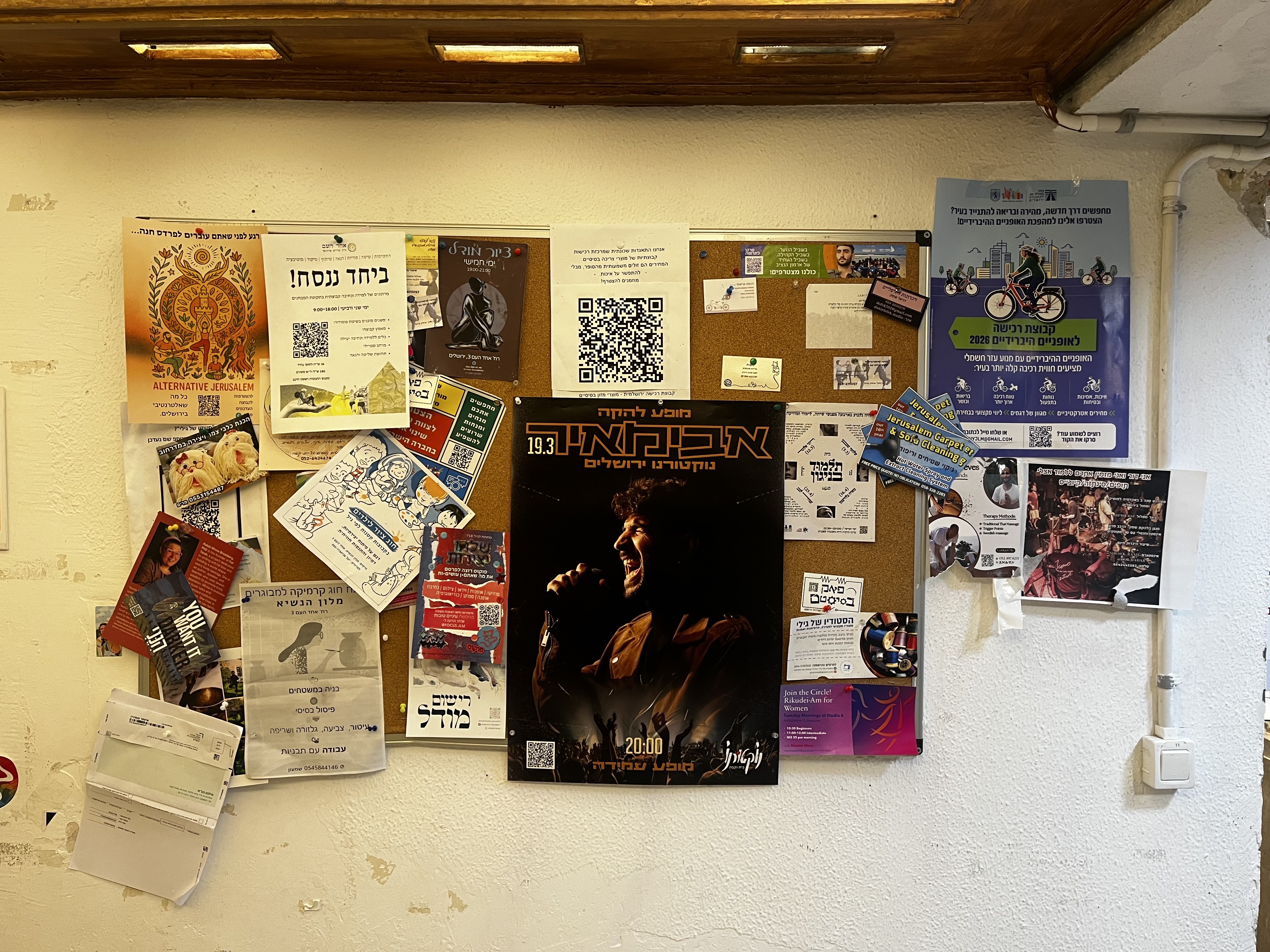
Many of these groups are joined with QR codes or links from others. They are advertised everywhere, especially in places like the Social Space, which is itself part of an initiative to create alternative zones of civil society in Jerusalem. When developers buy old buildings—like the long-abandoned President Hotel on Ahad Ha’am St.—they allow, in return for tax benefits, all kinds of community groups and organizations to use the structures while waiting for urban renewal permits. These structures become hubs for activities of all kinds, from artist studios, to dance classes, to exhibitions, to study rooms and prayer groups. Every one of them has its own WhatsApp group.
Some months ago, while sitting at The Garage—the Social Space’s café which doubles as a vintage store—I kept seeing all kinds of friends and acquaintances walking into the building around the same time. Finally, I asked one of them what was going on, and she explained that there was a pop-up food co-op that operated out of the Social Space once a month. People signed up to buy foods from a list sent in the first week of a given month and picked up their orders at the end of that month. The whole thing was run through WhatsApp. The person who told me this was not someone I knew well. To get the sign-up link we had to exchange phone numbers, which she sent me via WhatsApp. Just like that, I had a new contact in my phone—and a new WhatApp group.
Using these maps, parents in different WhatsApp groups began coordinating where our kids could meet up and play with immediate access to protected spaces. It brought the kids together. It brought us together. And it kept us safe.
None of this means that we’re immune from a new major catastrophe as a nation—another October 7 that will be bigger and worse than the first or the total collapse of our civic institutions. When Hamas promised more attacks of this kind, it reflected an effort far beyond its own borders and powers, and trying to underestimate the intentions behind such a carefully and systematically planned massacre only brings us back to square one. On the other hand, the way this government has exploited the attacks—using military force to change political realities in the Middle East while simultaneously pursuing illiberal policies that leave a silent tax-paying majority of the country disenfranchised—leaves the home front divided, scared, and exhausted. Yet the initiatives that will keep us alive could very well reach us through WhatsApp. Within a week of the outbreak of the current war with Iran—as parents throughout Jerusalem tried to figure out what to do with children whose educational institutions were closed until further notice—a message made its way through various WhatsApp groups with links to community-created maps of city parks that have bomb shelters. Using these maps, parents in different WhatsApp groups began coordinating where our kids could meet up and play with immediate access to protected spaces. It brought the kids together. It brought us together. And it kept us safe.
A new attack could come from anywhere, precisely the place we least expect it, and the government’s domestic policies do everything to ensure that such an attack is not only possible, but achieves even greater destruction. What neither Israel’s enemies nor its government take into account is that, by then, a whole new slew of WhatsApp groups will have been created—another infrastructural feat that will fill the void to save the people of this country from those who seek their death as well as those who exploit them—and maybe even put the country back in our hands.
What we cannot know until it happens is what Israel will look like when this government finally falls. But until then, we can cultivate all of our different WhatsApp groups, support the people who create them and keep them alive, pour our energies into the efforts of those who resist the spirit of this government by creating mini-worlds of their own, in which a different spirit reigns. One day, when the people in power fall or flee, someone will come and prepare a nostalgic book about this time, and the central motif of this book will be WhatsApp, and the way it gave the people of Israel a way to keep their spirits alive even when their own government tried to destroy it for good.