[drop-cap]
Nine months after Roe v. Wade was decided in 1973, California photographer Joanne Leonard chronicled her miscarriage in a cutting-edge series of twenty-nine photo-collages, Journal of a Miscarriage. On November 8, 1973, a month into the project, she constructed “Cactus Rape,” the first of its three cacti images. “Manuel and Joanne on Pear” came the next day. “Cactus Stab,” a few days later, on November 12. If you read each page narrowly through the lens of Leonard’s miscarriage, you have only to come to “Cactus Rape” to realize something more is at stake. Each title journalistically names what’s depicted, allowing the collages to traffic in the poetic metamorphosis of their materials.
Collage is a kind of violence, and it reveals violence. A fragment, the primary material of collage, is the aftermath of violence, a dismembering: what’s left after the miscarriage, unwanted feelings, tender flesh, questions, uncertainty, the assault of the whole blank day blazing into this demure baby being stabbed by a saguaro.
Though Leonard uses her actual blood on other pages of the collage, no images conjure bleeding quite like these rashes of red paint. We see both the bleeding and the inflicting weapon in “Cactus Rape” and “Cactus Stab.”
When I look at these images, blood pounds in my ears. It’s my heart in my ears. My heart beats as though I were there. In the nowhere of collage, but also in the Oakland hospital with her as she miscarries. In her bathroom, in the car, in the Septic Ward.
According to Leonard, the rape image is not a reference to a personal experience, but a pervasive atmosphere like a fog. The setting of a plot, a sentence repeating. These three images coalesce into a three-part narrative: the rape, the fruitful couple, the baby stabbing. But the image-events seem out of order.
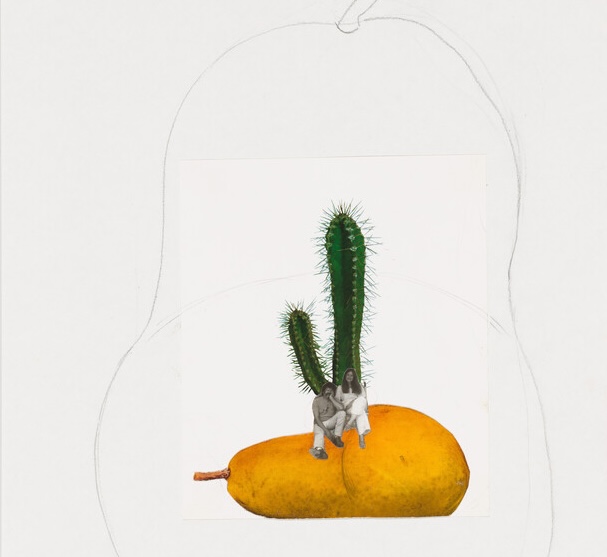
What is there to say about the middle image? A tiny snapshot of Joanne and her boyfriend sitting together on a pear, resting on its side like a fleshy rock. Behind them looms a two-pronged cactus, one large straight arm rising behind Joanne, a smaller, bent one, behind her boyfriend. The yellow pear is the only color. Around the image, where a heart might frame the happy couple, Leonard has penciled-in a cactus with spines like whiskers.
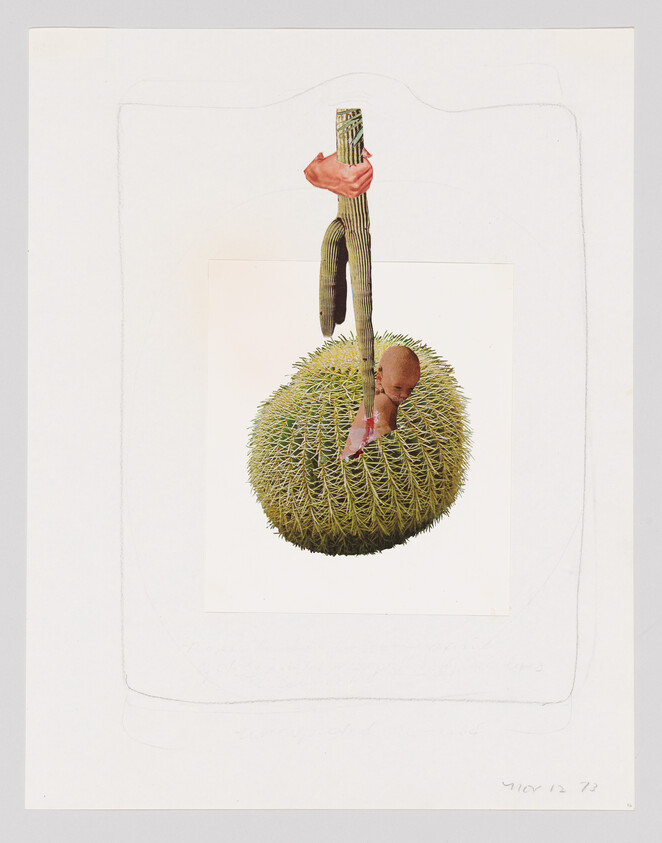
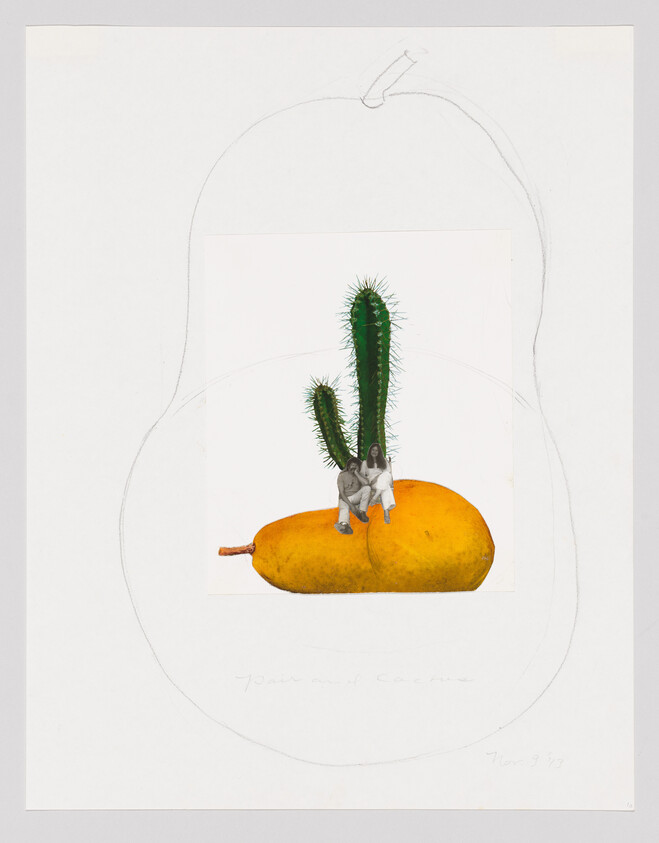
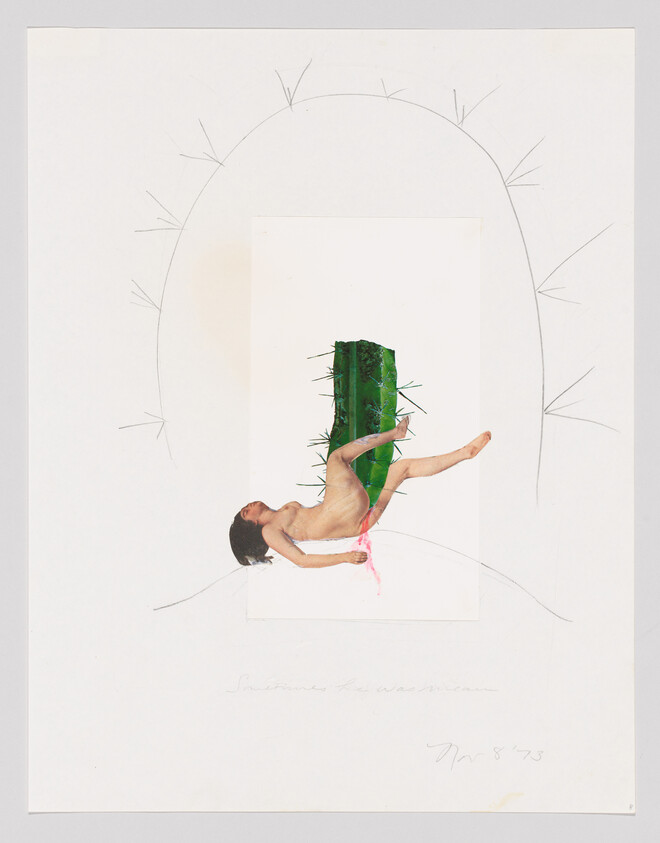
Three collages by Joanne Leonard: “Cactus Rape,” “Manuel and Joanne on Pear,” and “Cactus Stab,” from Journal of a Miscarriage, 1973. Courtesy of Joanne Leonard.
This page feels jarred awake by the ones flanking it. Violence and grief come in waves. This is the calm part, the part where you hold your breath, hold on to something nice and stable, knowing that danger looms all around you.
For feminized people, we are taught to think of our bodies through other people’s pleasure, especially male pleasure. Being a passive object, a people pleaser, excited by their excitement. How do we learn that our bodies are real? That they belong to us? A short list of what won’t teach us bodily autonomy, each in its own way: unwanted miscarriage, unwanted pregnancy, reproductive coercion, unconsentual sex.
My Word document shoves a wavy red line under “unconsentual,” indicating it’s an error or not a real word. Gaslighting is a function not a flaw of the system.
Is it easier—less contested—to see a cactus rather than a penis raping a woman?
When I say “woman,” I mean all people who identify as women or who have had experiences coded as such, either by choice or social context. Of course anyone can be a survivor, but the majority of victims are women and girls.
The woman in “Cactus Rape” is from a reproduction of Gustave Courbet’s The Sleepers (Le sommeil, 1866), which depicts two women entangled in post-coital sleep. Leonard extracted this sleeper from her companion, a model famous for being James Whistler’s (and likely Courbet’s) lover. Leonard uses the nineteenth-century figure to show us how little has changed in the era of the sexual revolution.
Femme bodily experience has always been subject to censure. Courbet’s painting, depicting sexual pleasure with no man in sight, was so scandalous in its day that its first public showing resulted in a police report. When Leonard’s Journal was first exhibited, the curator made a special room for it, hiding it away, and six years later, it was entirely removed from her retrospective at the University of Michigan Art Museum, her home institution, where she would teach for three decades. Recontextualized in collage, Courbet’s figure trades realist eroticism for surreal agony.
Leonard’s figure represents multiple selves interfacing: victimized, fantasized, fetishized, and antagonized. As personal as Leonard’s Journal is, though, she includes us. She gives shape to narratives we didn’t quite know how to express. With the second wave feminism of the ’70s and the passing of Roe v. Wade in 1973 came dramatically rising reports of rape. Rape rates weren’t necessarily rising, but rape came into our cultural consciousness as a crime. In 1973, the same year Leonard made her Journal, Our Bodies, Ourselves went mainstream with a newly added “Rape and Self-Defense” chapter.
“Volition” became “violation.”
Rape, like miscarriage, abides cultural formulations as an unspeakable singular tragedy, though it is far more common than aberrant. At least one in five pregnancies end in miscarriage. At least one in four women experienced sexual violence in their lifetime.
In art history, rape is well represented, but in these scenes penetration goes unseen. It happens without happening. The picture is an eroticized aftermath or preface. Impossible to see or name, surrounded by an insoluble fog saturating life under patriarchy. A voice forever asking, What rape? This disappearing act and clueless denial, this fucking gaslighting, fortifies the ongoing difficulties of reporting and adjudicating rape charges.
Leonard’s collages, even with their use of metaphor, make rape graphic. The viciousness of the cacti at least temporarily inoculates against erotic use. The Courbet figure turns away from sensuality to confront rape myths such as that rape is a kind of sex and not a kind of violence.
We read these collages as much as we see them. Loosely penciled lines slide Leonard’s loopy border sketches into captions of cursive text. Outlines encounter words, and where they meet buzzes with interference. The signal scrambles between ambivalence, togetherness, and crisis.
Rape, like miscarriage, abides cultural formulations as an unspeakable singular tragedy, though it is far more common than aberrant. At least one in five pregnancies end in miscarriage. At least one in four women experienced sexual violence in their lifetime.
Leonard faintly captions “Manuel and Joanne on Pear” with the words “Pear and Cactus,” the symbols she assigns through repetition to herself and her boyfriend in the series. Linguistically, they are presented as equals. Horticulturally, however, these plants make bad companions, unlikely to survive in the same soil. In this image the cactus seems to grow out of the fallen pear.
On “Cactus Stab” most of the words have been erased. The only barely legible language is “unexpected wound,” underneath an entirely erased sentence of seven to ten words. With this phantom text, Leonard palpably visualizes the shame-fueled silence that miscarriage demands. The pregnancy and the future baby have been written and rubbed out. Where words once made meaning, there are only the traces, aftershocks, impressions.
In erasing the words, Leonard paradoxically makes us speculate about them.
Under “Cactus Rape” Leonard has written: “Sometimes he was mean.” The startling juxtaposition between the violent image and the understated caption offers us a further understanding of how common language fails to name women’s experiences. As if “mean” were the only public language we have for sexual violence, the only way of being heard. “Sometimes he was mean.” Hear the unspoken end of that sentence like a heartbeat “to me, to me, to me.”
Meanwhile, we have more euphemisms for dick than anything on earth.
Recall Robert Glück’s four-page litany of expressive substitutions for his narrator’s cock in Jack the Modernist (here in no particular order): my inchworm, my garden god, my minaret, my little sparrow, my late string quartet, my date book, my hornet, my lance, my nose-job, my candle, my Bic, my unicorn, my cyclops, my drawbridge, my white whale, my yardstick…
Language seems designed to put the image of dick in my mind without my consent.
Though we see the cactus as undeniably phallic, it also could evoke maternity. Plainly visible to the naked eye: cacti are covered with nipples. Well, not nipples but the skin encircling the nipple, the areola. Your nipple is the bullseye of your areola, and the cactus has tiny ones all over. And maybe like your own, hairs, spines, flowers, new arms grow from them. “Areola” comes from the Latin word for “small, open space,” like a wound from which to grow.
Roland Barthes’ word “punctum” comes to mind. The thing which pricks us in a photograph.
The cacti in “Rape” and “Stab” especially transmit tactile texture. Along the edges, sensation activates memory and the feeling of touch. Prick, prick, and blood drips. The cactus stabs the woman between her legs and the baby’s tender backfat. Blood trickles. Can a punctum ever be a depiction of an actual wound?
The cactus, the vehicle in the metaphor, is a weapon, but it also stands watch like the Greek giant, Argus Panoptes. The all-seeing guard with a hundred eyes, like areole, all over his body. Hera commissioned him to keep an eye on Zeus’s “other woman.” Maybe voyeuristically surveilling, instead of watching over. When the giant died, Hera put all his eyes on the tail of a peacock. Beautiful to look at and blind.
The tie between silencing or dismissing women’s speech and sexual violence runs deep. Ovid names some enduring examples: Philomela, Callisto, Io, Daphne, Echo, Tacita, Lara. Cassandra can speak, but is cursed to not be believed, which describes the legal condition of women well.
What does any woman gain by itemizing what happens on the ground? In the field or forest, in the bathroom, in the office, in the frat house, in the cactus garden? Leonard refuses to stay silent about the interconnections between state and intimate violence, between men feeling entitled to control our bodies in court rooms and hospitals as well as in beds and backseats. She finds a method to show patterns in our collective lives.
A question blooms: do we throw the baby out with the cactus water? Leonard’s water broke and she was bleeding; everything was coming out. The brutality, the bonding, the baby.
Leonard’s romantic partner, Manuel Neri, was a first generation Mexican-American, then immersed in a white Bay Area art world. Neri was the father, or would have been if the baby had been more baby, less collection of cells, less miscarried embryo. She knew he wasn’t exactly, as she might have said at the time, “father material,” and that was fine by her. She thought maybe having a child would be easier without him there expecting dinner and clean, folded laundry. Without someone who would need to tend his cactus garden, sorry dear, while she carefully cut out an image of a saguaro with which to stab his baby.
The tie between silencing or dismissing women’s speech and sexual violence runs deep. Ovid names some enduring examples: Philomela, Callisto, Io, Daphne, Echo, Tacita, Lara. Cassandra can speak, but is cursed to not be believed, which describes the legal condition of women well.
She turned the saguaro upside-down and put it in a man’s hand so that it looks like the baby is being stabbed by a man masturbating. The baby—with the look of a frightened, fawning woman who thinks if she looks meek, she might not get hurt—is incongruously nestled in a big hairy green testicle. This type of cactus is actually called Ball Cactus.
Other than that: the baby is getting a good needling. The cactus needles the baby. In a D and C (dilation and curettage), which helps the pregnant body expel remaining embryonic tissue during and after a miscarriage, a doctor inserts a similarly shaped instrument.
More needle than cactus, more plunger, more hand job, more flesh, more battery operated, more blade. Language leaks, but rape is not a metaphor here. It’s called to as an image always in our minds, the most given of givens. It’s our landscape as well as an event within that landscape.
Leonard used Ed Ruscha’s book Colored People (1972) as source for the three cactus images. Ruscha’s book features all manner of succulents and palm trees, floating on a white featureless background. There’s no language except the title to guide us and no actual people anywhere in his book.
In a 1974 interview with Howardena Pindell, Ruscha says:
The objects in the book were affectionately called people—people “in color.” The title was a primary motivation in the creation of the book. I have blind faith in the title and blind faith in the pictures, and the two seemed to come together so compatibly in this instance. The plants may appear to be more Mexican than Negro but they are colored people, yes?
I like to think Leonard is exacting revenge on Ruscha’s racism, which identifies Mexican people with desert flora, itself dehumanizing and reductive, then further conflates Mexican people with Black people, flattening and marginalizing both groups. You might think Ruscha was embarrassed by his book, or that his racial politics eventually evolved.
In 1981, for Ruscha’s first major museum retrospective, Dave Hickey in the catalogue asks him about Colored People:
[Ruscha] looked sheepish and said, ‘Well, you know how those cactus [sic] look?’… He raised his hands, palms forward, up beside his head and shoot them in a perfect imitation of an old-time white-glove minstrel shuffling across the stage with a watermelon grin. The silhouette of the cactus and the minstrel were indeed similar, if you had a perverse state of mind.
Leonard says she picked the book because the cacti were already singled out, splashed on a blank background. When I ask Leonard, as we look through her basement archives, if her choice to use Ruscha’s racist stereotypes may have been unconscious, she says, of course, the civil rights were absolutely on her mind. She had just left West Oakland after nine years there, where she and her then-husband had been the only white people in her neighborhood. But to Leonard, the choice was more personal: Neri loved cactus plants and cultivated a beloved cactus garden. Leonard writes: “I had photographed him among the cacti.”
I envision Neri’s most enduring contribution to art as being Leonard’s model in his cactus garden. The gender reversal is amusing. But there is something else delicious about Leonard’s sentence, the grand “among the cacti.” I have photographed my partner in his garden many times, but it’s the “among the cacti” that makes me smile. A prick among pricks.
Another word comes into earshot: prickly pear cactus. Given the prominence of pears in the Journal, she might have gone for the rhyme. She might have cut out a prickly pear cactus with which to paddle Neri and Ruscha. Leonard also did not use bunny ear, rat tail, star, feather, barrel or any of the other thousand shapes of cactus; she carefully cut out the most phallic, the most testicular.
Zora Neale Hurson says it and Glenn Ligon paints it: “I feel most colored when I am thrown against a sharp white background.” But they are talking about Black people in a land of institutionalized racism. Ruscha embodies that sharp white background. He believes in whiteness’s mythic neutrality and purity, a fantasy of blankness where racist taxonomies can flourish unchecked.
In Ruscha’s work, we see the isolated cactus, which is meant for deserts, for landscapes, for scenes. His cacti don’t look like people, I think we can all agree; they look like alienated objects, emptied of meaning. Leonard puts Ruscha’s cactus into a scene and the penile qualities overtake it entirely. It’s a visual metaphor, but a linguistic pun.
My theory is that Leonard cut up Ruscha’s limited edition book as an act of retaliation, using his cactus without his consent. Leonard plants the word “prick” in my mind fifty years later. Like a magic trick of celestial proportions. Because “prick” comes from inside my own head, its gravity hits with the velocity of memory. It comes with the force of thought. But we have and will always summon bodies piece by piece, word by word: areola by leg by vulva by hand.
Penises are everywhere in our language, but femme and birthing bodies are mostly visual material. Our miscarriages, our abortions, our rapes, our harassment, our vulvas, our menstruation, our menopause: where do we find them? “Miscarriage” and “rape,” when spoken at all, spell trouble. No one wants to say or hear these words; they become a curse in the mouth or ear. These narratives go missing from our cultural vocabulary. This silence meets itself coming the other way. It populates itself with phantom language, haunted by its own absence.
In these three Journal collages, images hallucinate the unspoken stories inside us. The words missing from public discourse bubble up with the force of an internal thought. Leonard’s encrypted pictorial vocabulary materializes an extra-visual content and context to flesh out our understanding of her work. We come to trust the words, testing them, activating a body of experience, amazed at the speed with which they bring our whole, real world within reach.