[drop-cap]
Turn a corner too quickly on the usual shortcut to Sunset, and my car kicks up the metallic interior of reversed chip bags and leaves of perpetual fall. At a reading group someone asks—had I noticed how the air in Chinatown smells of mold and drywall since they began tearing down the old hospital at Hill and College? “Of course,” I say. But no, I hadn’t noticed the mildewed—dirt-smelling air. We eat poached pears and talk about a book where a woman wakes up to the same morning over and over again. My knife slips from the firm side of the pear and rings when it smacks into the side of the porcelain plate. The day in the book repeats. The woman in the book walks further and further into the field of that day. While time condenses, space stretches out. A friend comes back from New York. Says that Los Angeles is filthy. A week later my back is turned while my cat slips out the front door. When hunting for him I run into the razor-thin silhouette of a woman stooped low over the neighbor’s flowerbeds. She’s peeling shreds of orange from the ground, telling me she will move the seeds elsewhere. We’re both surprised to see each other standing there.
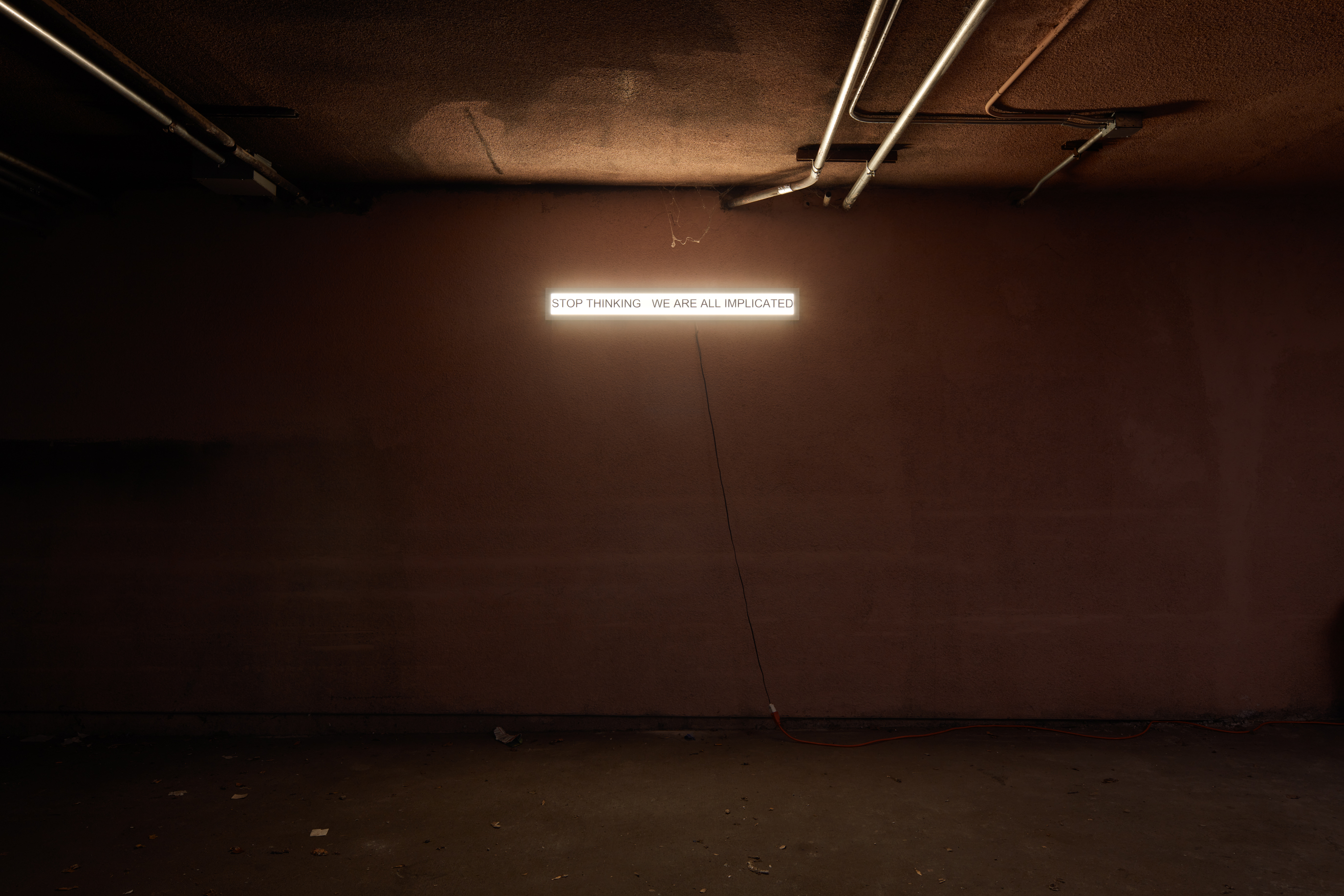
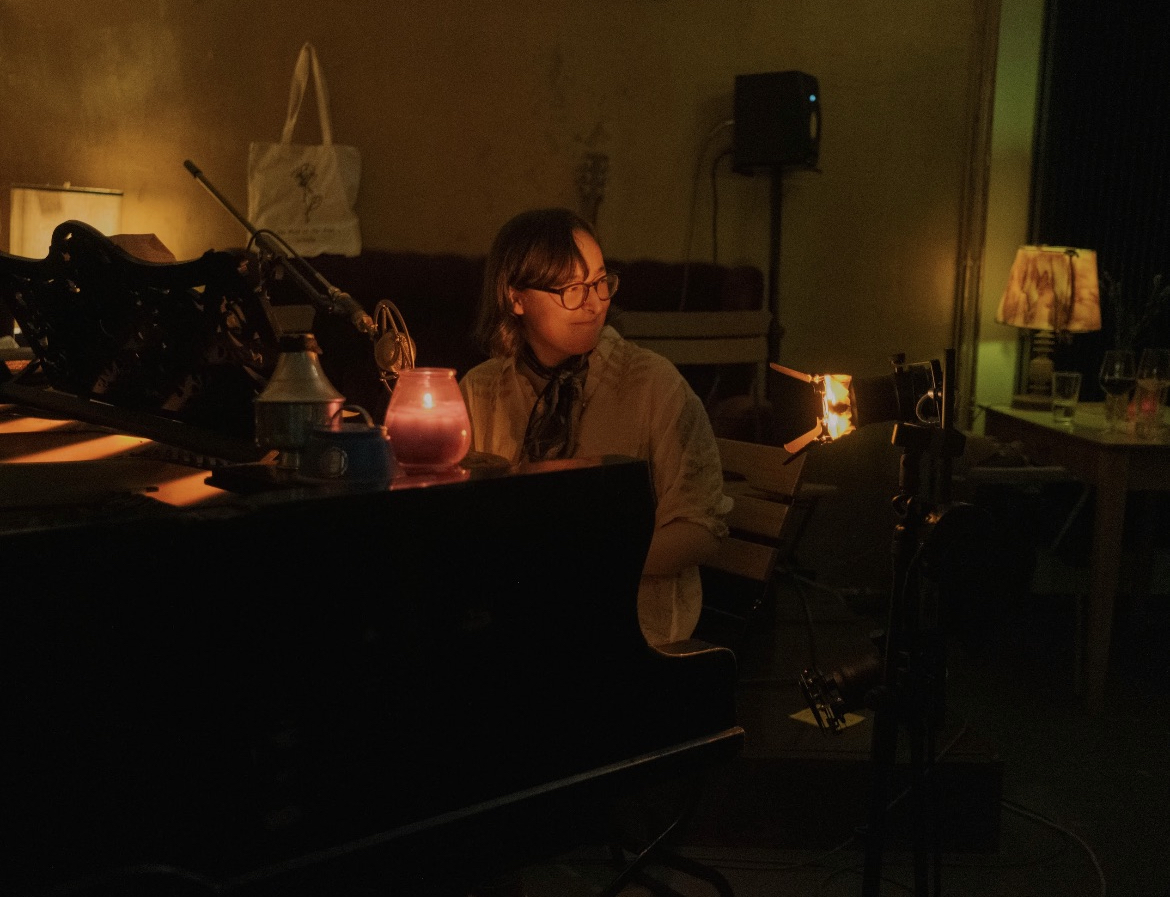
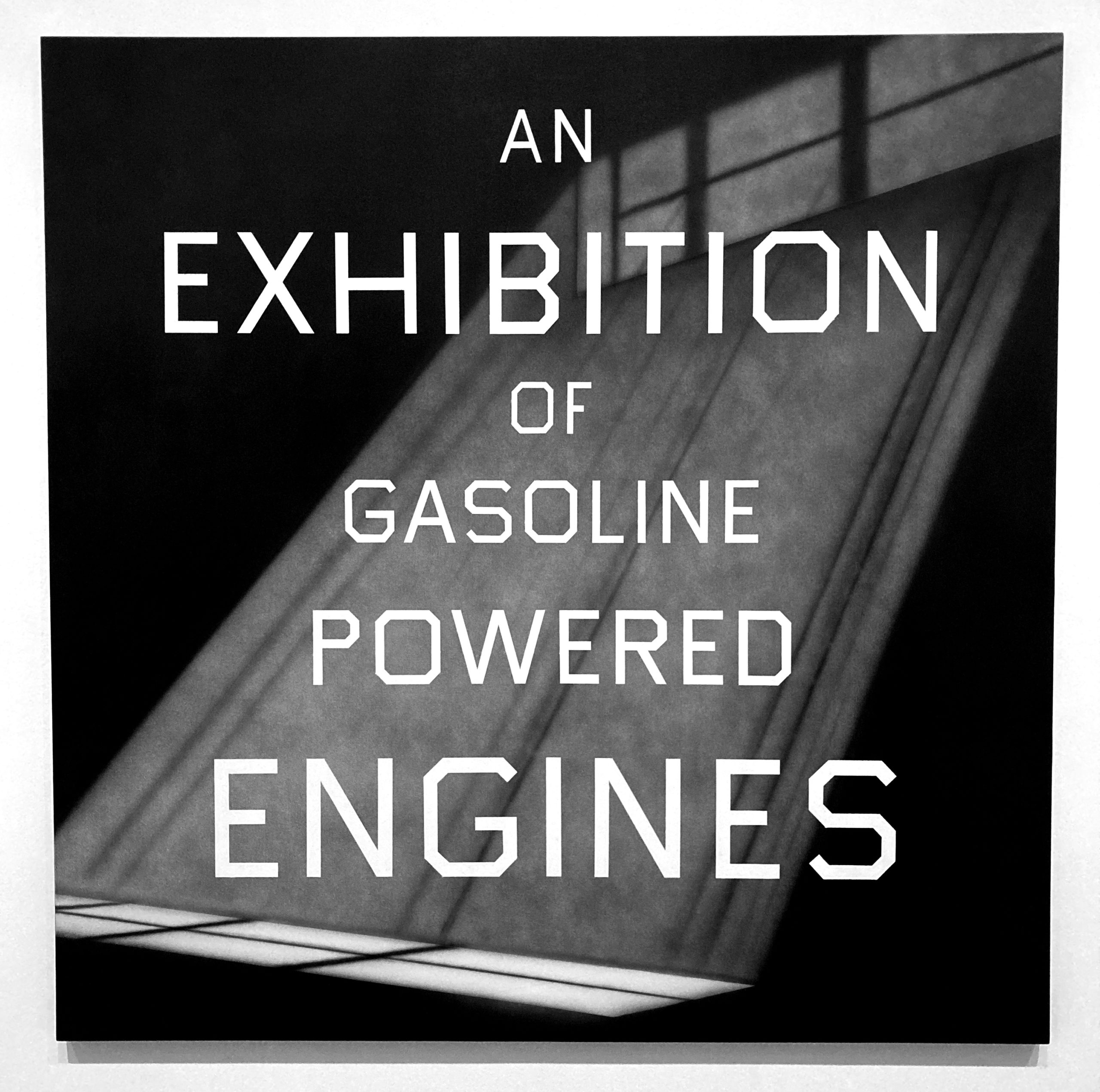
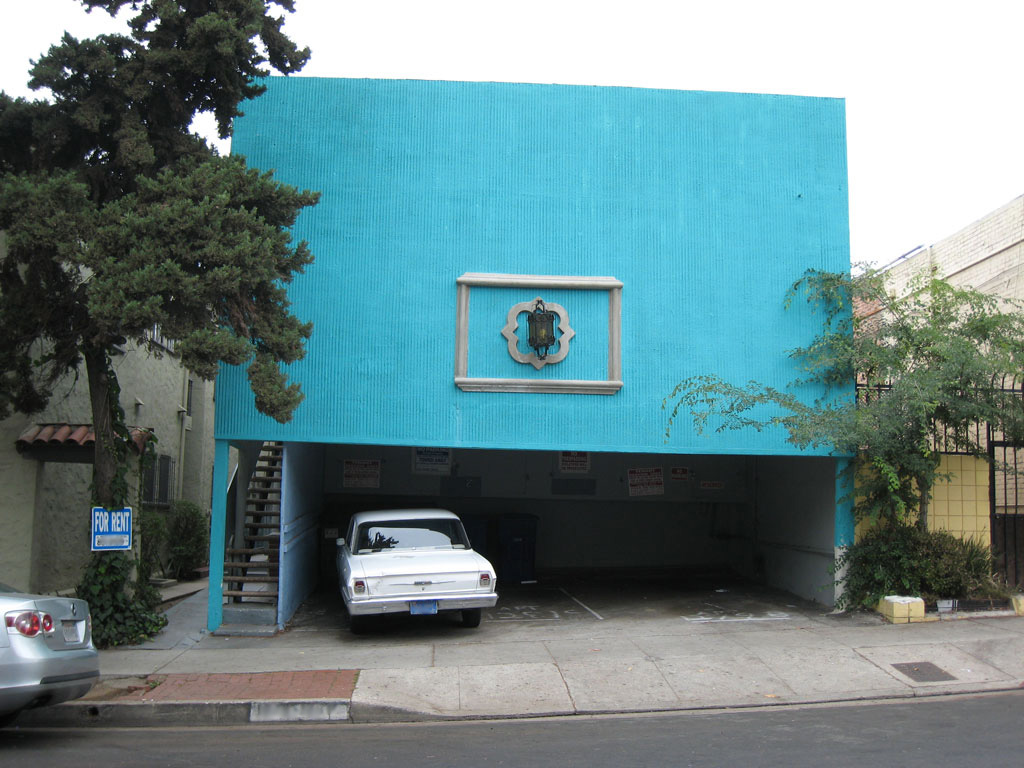
You won’t notice the lit-up sign with black vinyl letters hanging over the singular square patch of unstained wall in the Leroy’s parking garage: “STOP THINKING WE ARE ALL IMPLICATED” until you’ve smoked a couple of cigarettes, finished half a drink, muddled your way through a few conversations. You’re seated at one of the tables that fill the third of the garage outside of the gallery entrance.
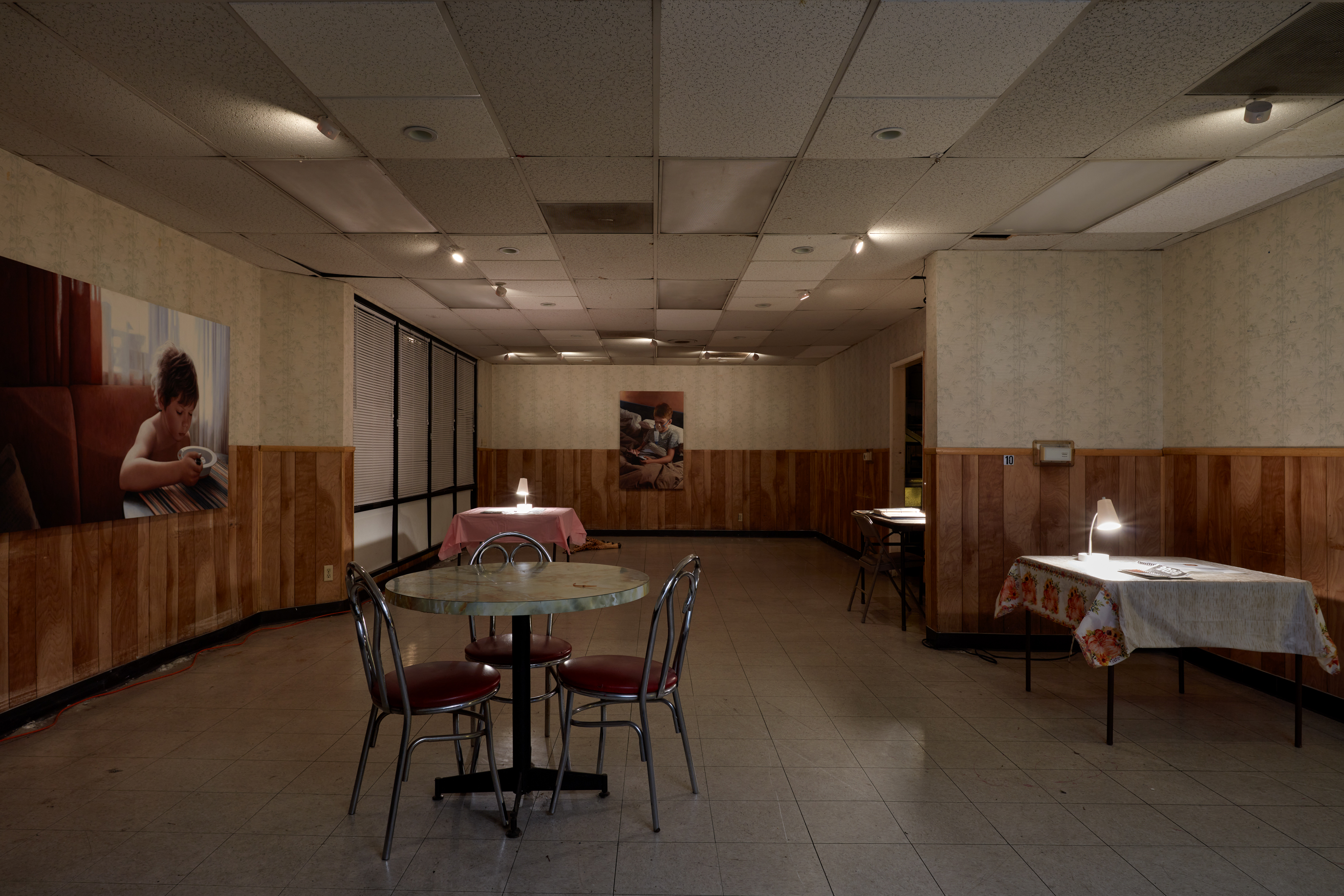
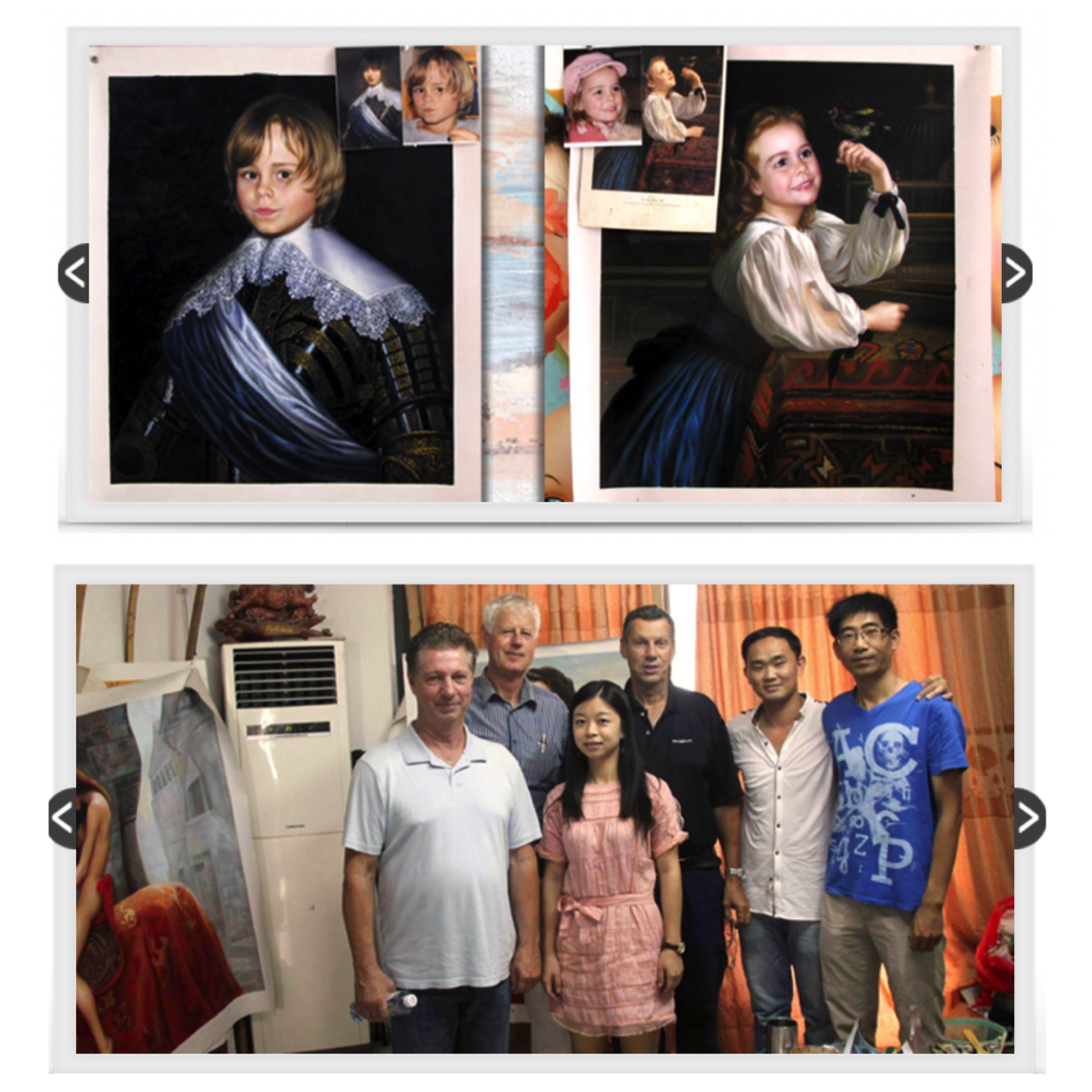
Inside the former Vietnamese Restaurant hang several photorealistic paintings of sick and recovering children. These could be images from a campaign for at-home medical treatment if the light in them were not handled with such belabored, beautiful care. The paintings are fabricated by a small company in Xiamen, a port city on the southeastern coast of China. The company can reproduce paintings of any style: the website claims Xiamen as the “center of the oil painting wholesale industry,” and divides sample paintings by artist and subject. The compositions teeter between filmic and commercial. A child dips his head into a halo of blurred yellow, white, and pink—a vestige of a fictitious camera. The halo aligns with the arc of his chin. Another child wears a respirator so plastic it could be peeled away from the painting. On the same canvas, a patch of rust in the background announces itself as entirely material, only paint. The hands of the makers show themselves.
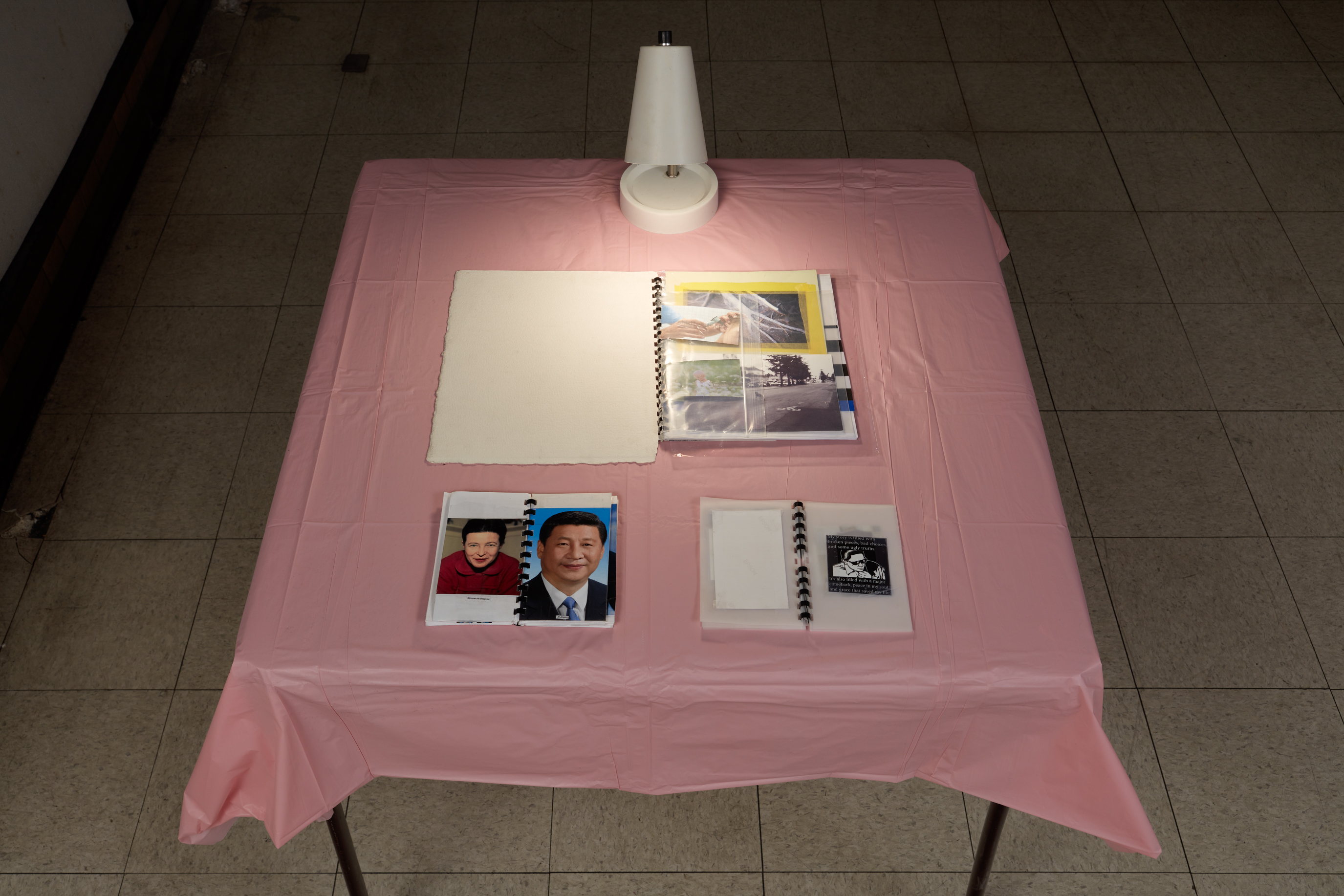
Reading tables bearing mismatched desk lamps and a series of artist books circle between the dining room and kitchen. Joan of Arc and various instances of child cannibalism, speculative hospital architectures and Midas 62, the pieta and Pablo Picasso’s childhood trauma. The chasm left in the wake of the books’ constellated subject matter is as wide as it is vacuous. Together, the paintings and books take up the worn-out model of the artist’s studio as factory and artistic production as fabrication and stretches that model to the scale of long-fraught trade routes. There’s the exchange between the United States and China; the delocalized pull between the body and its image; capitalism’s sequestering of innocence away from the child and onto the image of the child.
Looking from the books to the window-sized paintings, I am confronted with the flimsy boundaries constructed between the sickness of the world and the sickness of the paintings, between the sickness of myself and another, between the sickness of this time and the past. Sickness is the unavoidable ground we have found ourselves standing in, as identity is digitally accumulated into an image that might operate apart from us. The contemporary moment treats body and psyche as trash, disposable, and the image as commodity. Many nights of the past year, I’ve heard helicopters circling low over the IceOut LA protests downtown from my windows before waking to videos documenting the destruction of life at the whim of one state or another. All the while, we continue to produce a phantasm—the dream image of ourselves—in the same digital space where we witness this violence. If one has the privilege of being compelled to care for the body: that body is at most technology to be crudely resurfaced according to trend. The body must always maintain a shape in which the image will hold.
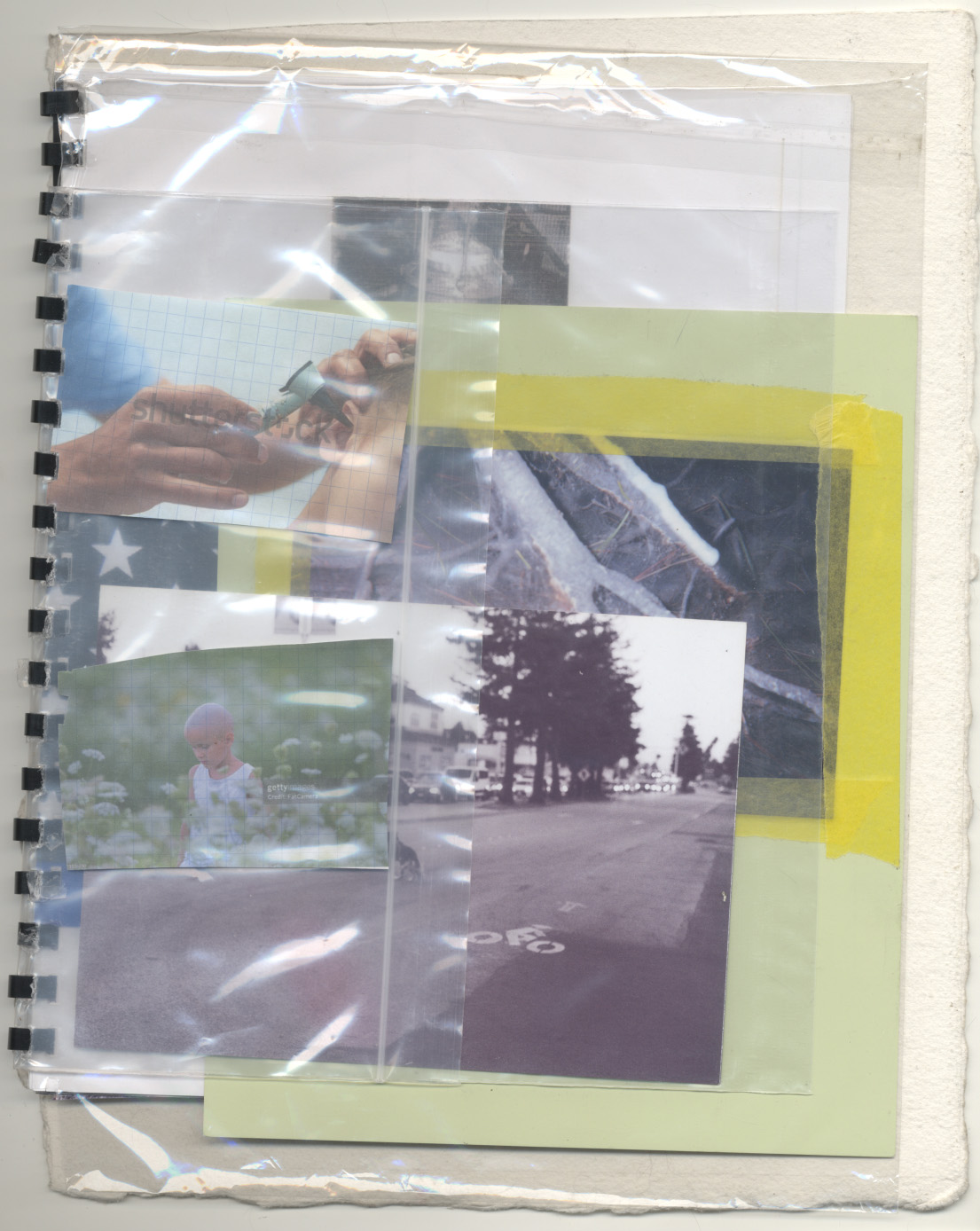
The artist books in Public life Subscriptions amass digital detritus from a memory that began long before the internet and embed it in the books' physical bodies. The edges of that materialized memory are plural. It is impossible to extricate one seam from many… This is a model in which memory is mutually constructed. Memes, porn ads, hospital communique, and Wikipedia articles are taped or pasted onto loose leaf paper between fragments of Klahr’s writing. A ziploc bag sutured into the binding of A Caregiver’s Guide holds an image of a child with no hair in a field of white flowers and above this an ear with the device used to magnify its insides. Who can remember the name of this device? The little window through which the doctor can presumably see your ear canal, but to the lay person, it’s just fog. Who can remember being innocent? Behind the ziploc bag holding the image of a child there is a street scene. A black and white photo of someone’s dog running away from the camera toward paused traffic.
-45.jpg)
In the 1947 book Gravity and Grace, Simone Weil writes, “There is always a relationship to time to be taken into account. We must get rid of the illusion of possessing time. We must become incarnated.” According to Weil, time does not exist outside of the present. Yet we submit to its imagined conditions and divide our moments as passing seconds. There is no before and after of the associative fervor driving Public life Subscriptions. Appropriated texts repeat themselves across the artist books in the show, despite their varied subject matter. The viewer is left to witness a collection of discrete points in time which ultimately look remarkably similar. At this uncannily smoothed surface of appropriation, the present repeats itself without being made new.
The artist book Joan of Arc and Child Cannibalism opens with a meme: “I move off vibes 100 You ain’t gotta tell me nothing I can already feel it” alongside an image of the Virgin Mary with a fat baby Jesus in her arms. The nature of Joan of Arc’s visions is debated in the near and more distant past. At 19, Joan of Arc is given up to her visions of angels and grandeur. In the book, the child both eats and is eaten. In a collaged interlude toward the text’s end, a bored child visits an Appalachian town in Kentucky with his family. The child, Daniel, is welcomed by Ruth and Joe Darragh, an elderly couple. Ruth sings of the “mountain childers,” cannibalistic children rumored to have haunted the Darragh family for generations. The next time Daniel visits the Darraghs they are hosting a boy and girl around Daniel’s age. The Darraghs claim the children as distant relatives. Daniel is frightened by the children’s silence: the way they eat with their mouths mostly closed. Ruth and Joe Darragh become suddenly emaciated. Soon after, they disappear entirely.
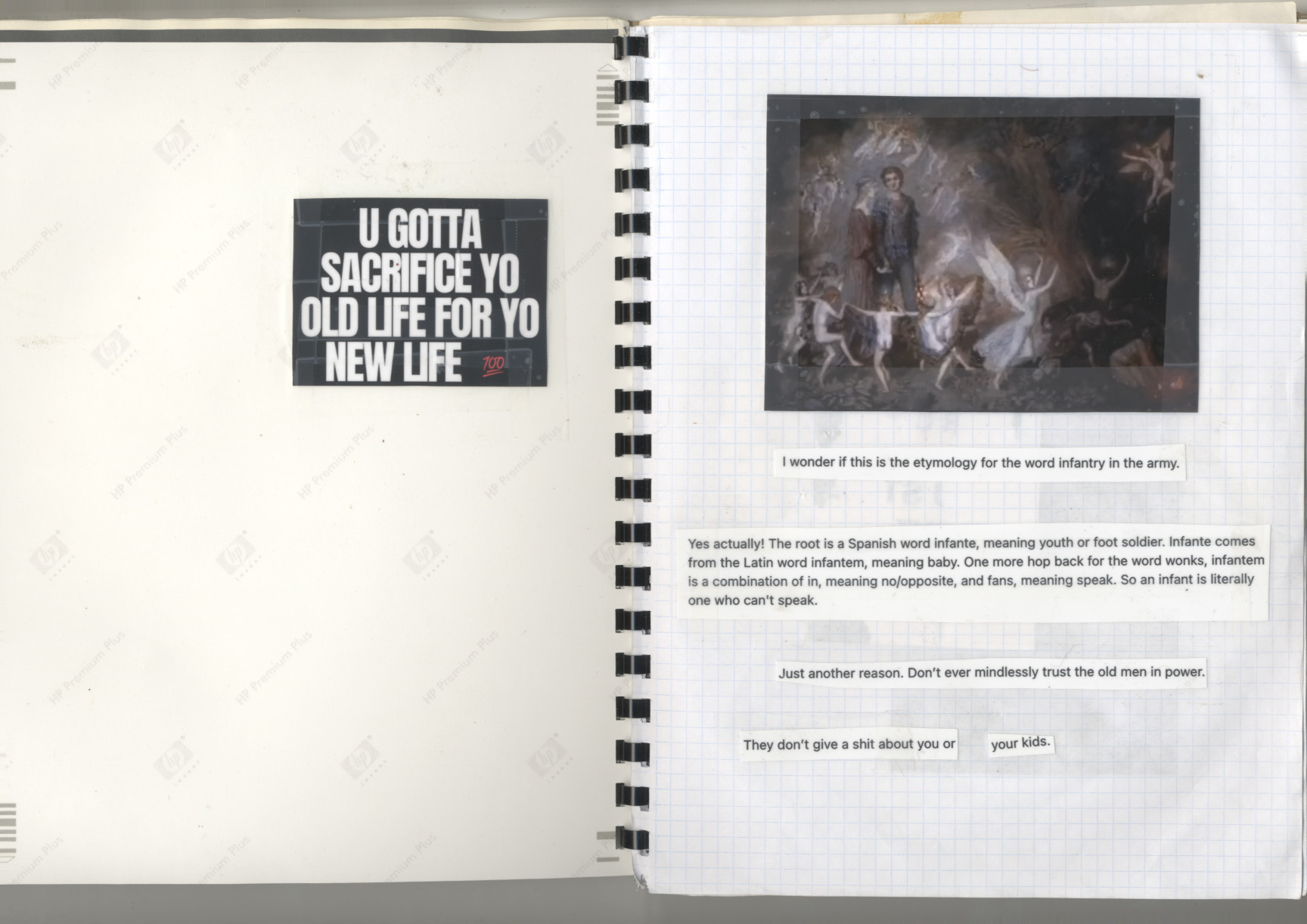
The Children's Crusades are included under the text’s broad heading of “child cannibalism.” It is the bewildered innocence, the blind and misplaced faith of the children’s crusaders, that inspire their ill-formed attempts to retake the Holy Land. It is the same innocence upon which merchants preyed when they offered some of the crusaders safe passage but instead sold the children into slavery. The artist books frequently return to a sliver of text from the The Children’s Crusade, a 1980s musical—
YOUNGER BOYS SING: “NO IT’S A DREAM OF FROWNS AND FEARS. THEY LEAVE NO TRACE WHEN THE MIRROR CLEARS.”
OLDER BOYS SING: “PRUDENCE, COURAGE, JUSTICE, TEMPERANCE, THESE WILL TEACH US AS WE GROW TALL.”
The boys sing of the strange loneliness of being morally prepared in the image of innocence for a future that never seems to arrive. An “I” that encounters itself only in reflection is easily split from its image. We give ourselves over to the language of possession from the beginning. We have no time, but there is an always. Innocence appears in the mirror but never belongs to the child.
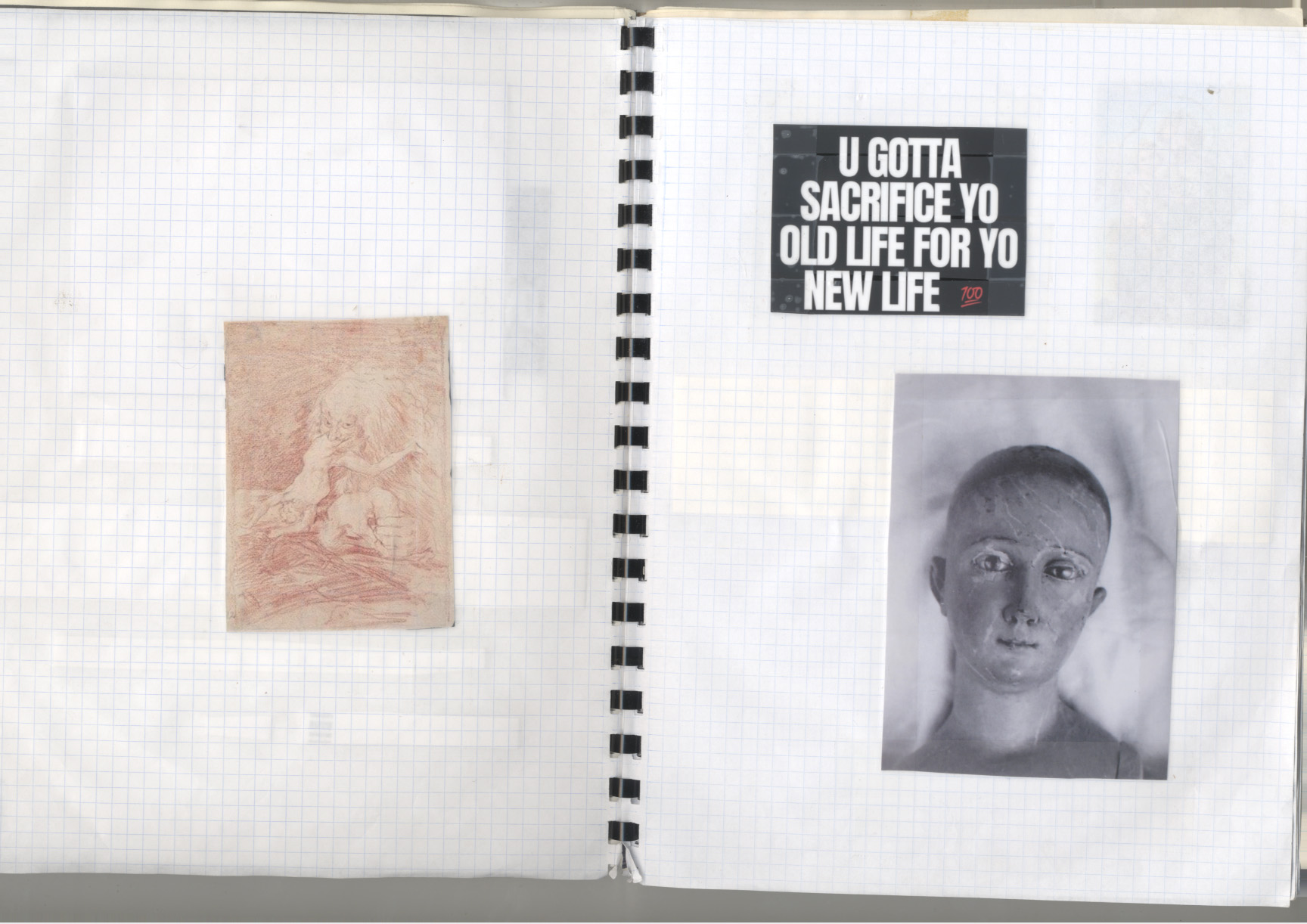
A consistent voice which comes from nowhere and comes from the internet moves through the amassed texts in Public life Subscriptions. The artist's own writing takes on the tumultuous spill of a Wikipedia article. In the comments section, unnamed actors hurl quotes from ancient reality television shows at one another. Occasionally, a self embeds itself in the patchwork of appropriated language. When the self does show up, as it does in the Michael Jackson Reader, it’s fledgling and forgone—always already looking backward for a somewhere or someone else:
And I am a wreck.
The city is a wreck.
I go to art galleries where there’s a lot of people looking at shit that doesn’t really say
anything to anyone
It doesn’t even speak the same language
One that is low and dirty enough
It seems the only game in town is getting fucked.
“I was impregnated by MJs dead alien spirit/ My time was mixed with his blood,” writes Klahr. Where Klahr’s voice leaks through the texts, it mostly sets aside the “I” to continue its searching.
-39.jpg)
On the way home from work, the reflective plating in its side makes a building appear briefly as if it were just another part of the sky. Convex, the building holds the sky in its upper middle fourth. In Los Angeles, everything speaks in this aired-up and plastic vernacular. We could be watching anyone’s television show. Art is fabricating art. We are entertained but we are not saying anyone’s names.
We stand around in the streets and in the parking garages making language together. We’re talking about our day. What we are making. We are telling each other about our dreams. We are trading our images. As the night goes on, the language becomes more and more repetitive. We live in LA, and we fuck the LA artists. In the morning, we are stunned by an absence. Or, we wake up with the arm of one of these people we make language with tossed over our backs. Without turning to look at them, we imagine the pressure drawn across us as the shiny arm of a man-made lake. There is an innocence which never happened and a whole other town at the bottom of the lake, but you’ll never see it. Everything can only give the impression of itself.
But perhaps we have not exhausted our looking. Perhaps we have not looked hard enough or elsewhere.
One way to continue looking is to take up a kind of play-acting. To dress ourselves up in the guise of a different moment. In Klahr’s artist book, Joan of Arc and Child Cannibalism, near documentary accounts of the actresses engrossed in character-study ultimately slip into ventriloquy. In an attempt to understand why Joan of Arc might falsely admit that her visions came not from the angels but from the devil, the actress who portrayed her in Carl Dreyer’s silent film, Renée Falconetti, pulled a metal sheet with blunt spikes on top of herself. Under this pressure, the voice of the text becomes more personal, as if the voice in the text is intuitively and clumsily trying to get into character:
and it feels good in a strange way…and she lets her hands which had been holding the plate go limp and although it’s heavy, it’s not that heavy…but as she relaxes and lets the weight of it sink into her flesh it starts to feel less good, and then it starts to hurt.
The book moves onto Mercedes McCambridge whose understanding of herself was effaced so that she could step into her small role in the 1958 Orson Welles movie, Touch of Evil. Welles covered McCambridge’s hair in black shoe polish, sculpted it into a boyish crop, and told her, “Basically, You are the devil.” Here again, a nearly documentary account becomes something else entirely in a non-sequitur jump to The Exorcist, another film in which McCambridge made a small but pivotal appearance. Years before Touch of Evil, McCambridge remained uncredited for her gravelly voice acting that brought to life the presence of the devil in the film’s possessed central character. Klahr writes, an intrusion of his own voice into the movements of the text, “It’s not that the devil is incapable of love. It’s just that what the devil calls love, we call evil.” The devil needs a place to stay and so he occupied the body of the young girl in The Exorcist. The voice of the text moves with a humor and dexterity that is graceful even where it stumbles intentionally. Evil is love. With empathy, always occupation.
The Simone Weil Reader begins with an image of Simone Weil’s gravesite and ends with extensive excerpts of On the Abolition of All Political Parties and Gravity and Grace. Gravity and Grace was compiled posthumously from the writing Weil produced while starving herself in an attempt to consume only the amount of food given to an individual in occupied France. She writes, “Man has to perform an act of incarnation for he is disembodied by his imagination. What comes to us from Satan is our imagination.” What occurs beyond the material present is illusion. Man removes himself from the present moment to ascribe value to the objects of the world. The books in Public life Subscriptions dirty up with splashes of beer and liquor from the lips or fingers of the viewers. The little splotches dry into gray film that formally echoes the tape that holds the books together. By chance, a car parked in the garage for one of the events programmed to accompany the run of the show, “Maid Café,” further obscures the sign bearing the words “STOP THINKING WE ARE ALL IMPLICATED” with the huge anime girl painted down its side. The anime girl’s exposed flesh matches the car’s mauve curtains.
Ultimately, Weil died to make room for God. Or rather, she died in an effort to return to God the space she believed he made available to her by departing from earth. Klahr’s methods of appropriation provide residence, if only residence in limbo, to the voices of many: Rennée Falconetti, Micheal Jackson, Mercedes McCambridge, countless identities obscured beneath internet usernames. In doing so, Public life Subscriptions reinscribes Weil’s infamous act of self-erasure and pokes at the boundaries of empathy. Appropriation moves with consumptive hunger. There is an honesty to this. Empathy does not exist without ventriloquy. Empathy does not exist without occupation. Attention is the only offering:
Maybe the best skill to have is not to be able to will a new reality to existence but to be able to be/ soooo open/ sooooo curious/ and soooo humble/ you become someone capable of allowing reality and existence to speak through you.
We might make of subjectivity a blank space in which the other could choose to uncover itself.
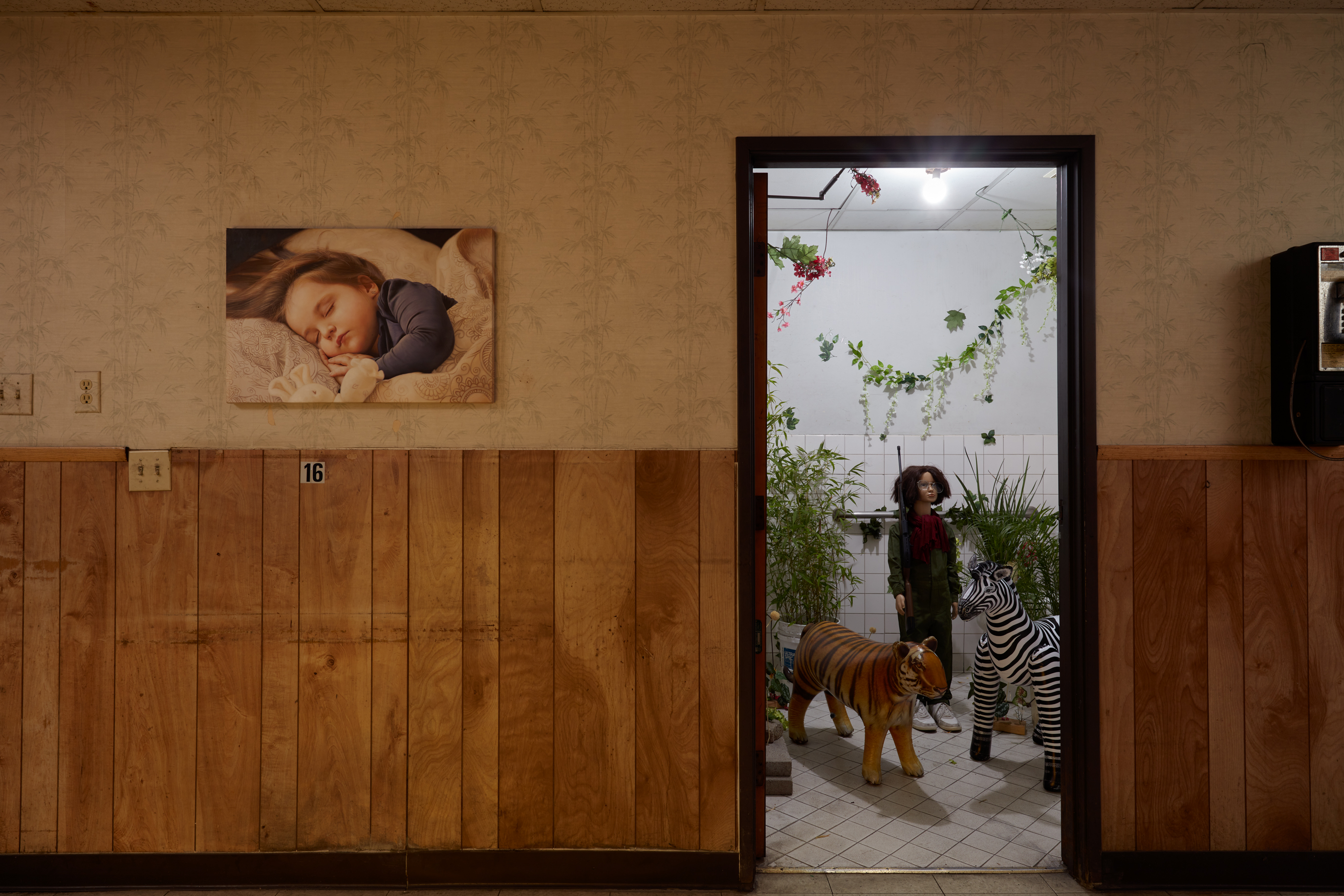
The show begins and ends with a child-sized mannequin dressed as Simone Weil and carrying a machine gun. She stands in the bathroom surrounded by plastic foliage and an inflatable tiger and zebra. The brightness of the bathroom ruptures the otherwise dim gallery. Looking into the bathroom is like looking at a diorama made by a child of a place that does not exist. In situating the annunciations of the internet in the decidedly anachronistic form of an artist book, Public life Subscriptions points to the way our voices have already begun in each other. We have concocted the dream according to the language made already available to us. The physical memory offered up in the books begs the question: do our illusions indeed become entrenched in our reality? Who gets to participate in deciding the shape of that reality?
Not every voice has been let into the dream. But does it remain possible to write an illusion in which all voices are free and welcome to participate? This language is not low and dirty enough yet. However the reimagination initiated by Public life Subscriptions has returned the noise of the world to the gallery space. This comes when the scene at large seems to have surreptitiously taken to echoing LA’s abrasive sunlight, that false and anesthetizing brightness effacing the underlying structure of the city. The show relies on the idiosyncrasies of the bodies and psyches that make objects we all gather to look at. It does so during yet another political moment when the bodies of our most vulnerable and vital are destroyed casually.
Public life Subscriptions
Ran Dec 20th – Jan 10th, 2025-26
Leroy's
422 Ord St. Chinatown
Los Angeles, CA 90012