[drop-cap]
It’s a rainy day in Tuscany, late in November. I skip Volterra, where I had planned to see Rosso Fiorentino’s Deposition but now I simply want to keep driving to find the sun. So, I head on to Pietrasanta, a city I was led to believe was a haven for experimental sculpture, discovering it for myself online after searching for Gustavo Aceves and seeing images of the whole town square given over to his weird deconstructed horse-skeletons. When I get there, however, there is a black hole of info—a map at the main parking lot seems to indicate open-air sculptures but there is no clear concentration, the online maps are difficult to navigate, phone service is spotty. I walk to the main piazza and ask a few women at a cafe about the sculptures. They are confused by my request.
Admittedly, this is all my fault. The parking lot is called the Piazza Statuto, so I’m not using the Italian word for “statue” or “sculpture,” but by sheer force of suggestion asking about the “statuti”: “Where are the laws?” Worth reflecting on the relation of the word “statue” to that for “statute” or even “state.” Added to this addled translation, after I order, I take a table and look out onto the main piazza, junked up with Christmas sculpture—a teddy bear of trussed tinsel, a toy train. I ruefully gaze at them, no better than can be found at any mall in America, while sipping espresso from a cafe where Michelangelo once lived. An old-timer at another table pontificates, seemingly full of self-irony because he’s most likely only a prematurely-aged Gen X Italian who has taken up the mantle of the town’s sage and blowhard. I can’t tell what he’s saying, but it sounds like podcaster bloviation. His more legitimately ancient companion at the table is silent, hunched over his cig and wearing a Mithraic red cap. The waitress joins in what one senses may be an eternal tableau.
The sun starts to peek out, barely, the Tuscan sun that can help to make sculpture out of any pebble. . . but not this horrendous holiday half-wittery I’m staring at. I continue to struggle with the town's website; I still don’t know if I am in the right place, and if I am, are the notable sculptures inside or open-air? It feels like I’m caught between what the Chamber of Commerce wants me to see and the actual attraction. I walk back to the parking lot, maybe to add more time to the meter (because, you know, there are statue and there are also statuti), but also weighing the possibility of once again taking to the road to look for the elusive and transformative sun. What I do start to notice here and there is the ordinary life that goes on around the few sculptures I encounter—nonnas with their shopping bags meeting strange concretisms, compelling, but not nearly exemplary enough to warrant staying another two hours.


Then I turn a corner and see Igor Mitoraj’s Centaur, which corresponds to the full intercession of the autumn sun. This centaur, suddenly sollegiato, finally lets me know I am in the right place. The centaur is usually a bifurcated being, but if that bifurcation were not enough, Mitoraj's version contains frames and cells of other figures in the buttocks of his horse-parts, in the chest of the man-part. Wounded angels with bandaged heads on the base. An inscription—evocative yet untranslatable—refers to the flight of eros, the return of blue, blood in the dust, the sadness of olive. As with Aceves, Mitoraj is known for figures that seem like fake archeology, finding the modern surreal latent in the idea of ruin, the future implicit in antiquity’s defamiliarized distance. (See for instance his Icarus Fallen cannily installed in the actual ruins of the Valley of the Temples at Agrigento in Sicily, ancient astronaut of our higher ambitions wrecked. Similarly, a version of his Centaur cast in 1994 now stands in the ruins of Pompeii.)

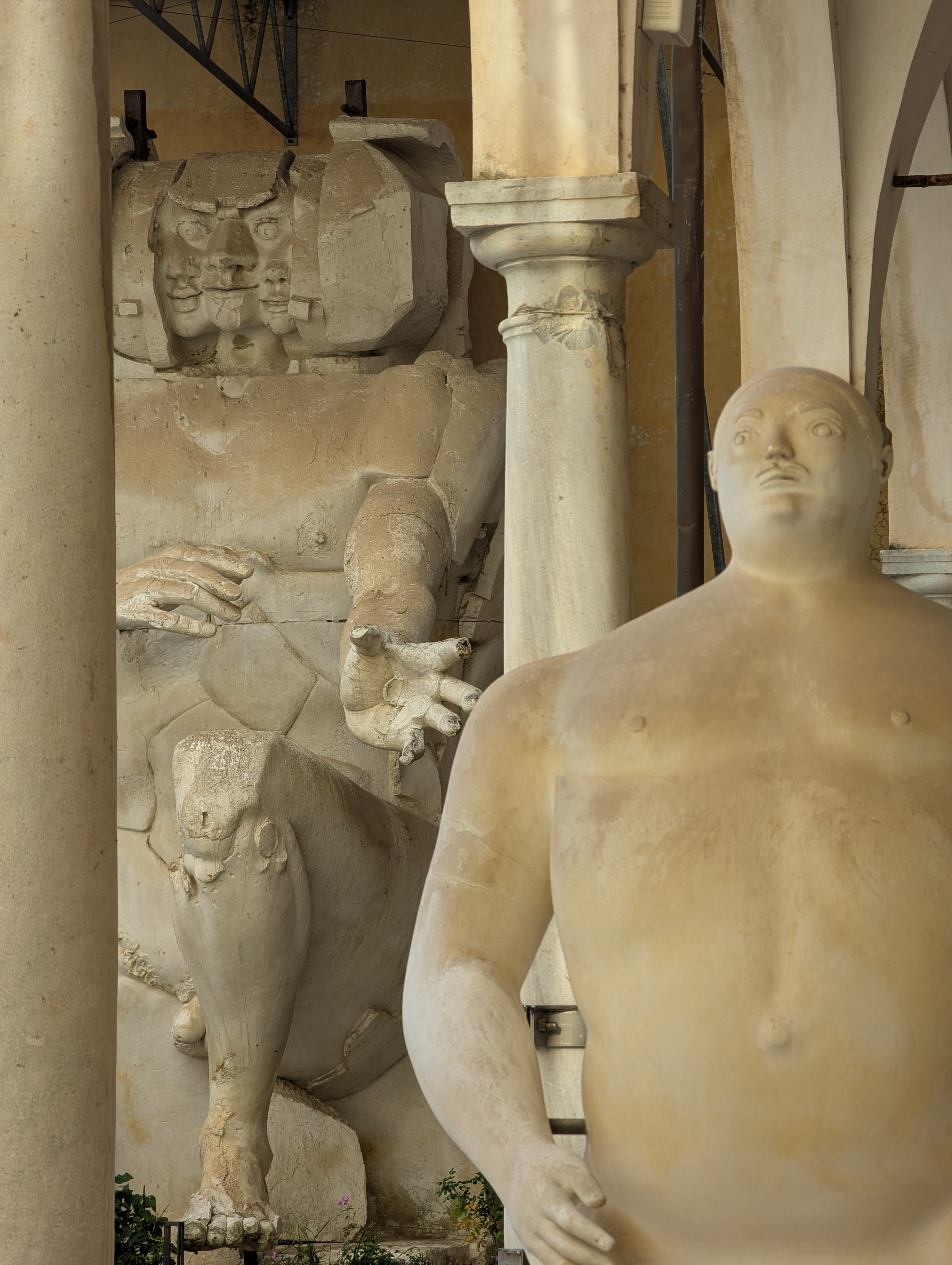
Turns out, I have passed the town’s main museum now three or four times, closed during pranzo but also almost invisible behind scaffolding. No signs indicate its presence and the entrances are so laissez-faire that testing the doors seems like trespassing. Another translational error: no way for me to know that Museo dei Bozzetti on the city maps is the main thing I should be looking for, not knowing the word “bozzetti” nor even its translation, “maquette”: a French loan word used to describe a cheap model or replica of a statue made before it is fashioned in bronze or marble. Once beyond this first unmarked door, I enter a portico jammed with a jumble of these full-sized maquettes from the classical to the Lovecraftian—at the far end of the portico is Karl Hartung’s eldritch Thronoi poised next to something that seems like an Apollo or one of Michelangelo’s Slaves finally liberated from marble. Though most of these sculptures are intended for marble or bronze—the proximity to the Carrara quarries has determined the fate of this town—what I am looking at in this portico are previsualizations in gesso, the ghosts of statues or perhaps better their spirits or thought-forms. This bizarre family of powder-white figures represents the collectivity of statuary concepts before they are cast, after which their more solid doppelgangers are cast away to all corners of the earth. Within meters of each other you see chalky versions, for instance, of Jean-Robert Ipoustéguy’s gargantuan Ecbatane (its bronzed counterpart now in front of a condemned brutalist building in Berlin), William McElcheran’s bloated Encounter (on a college campus in Toronto), and Leone Tommasi’s lithe V Tiempo 2 de VI Sinfonia Beethoven (enwrapped in the trees of a botanical garden of Buenos Aires).
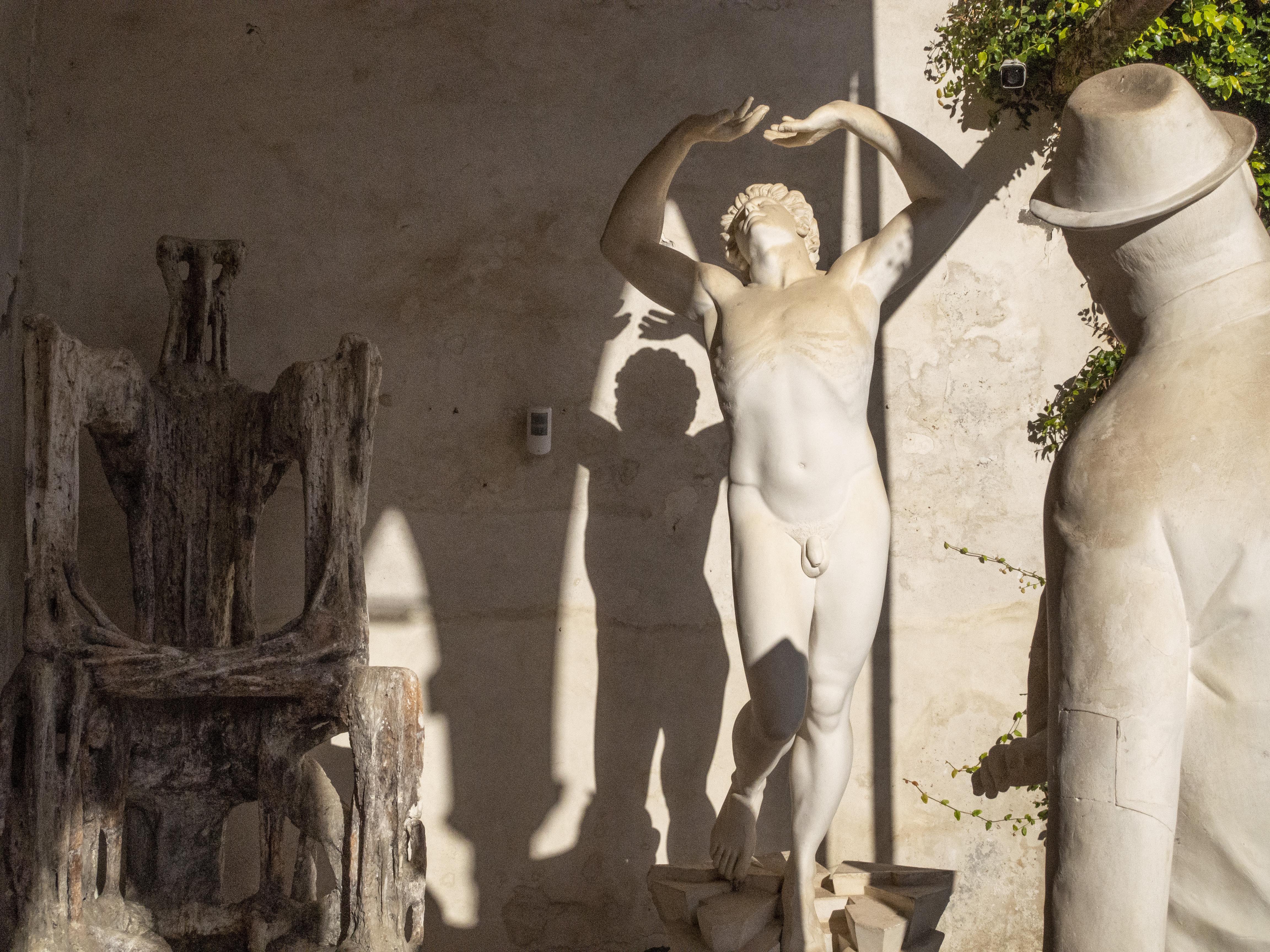
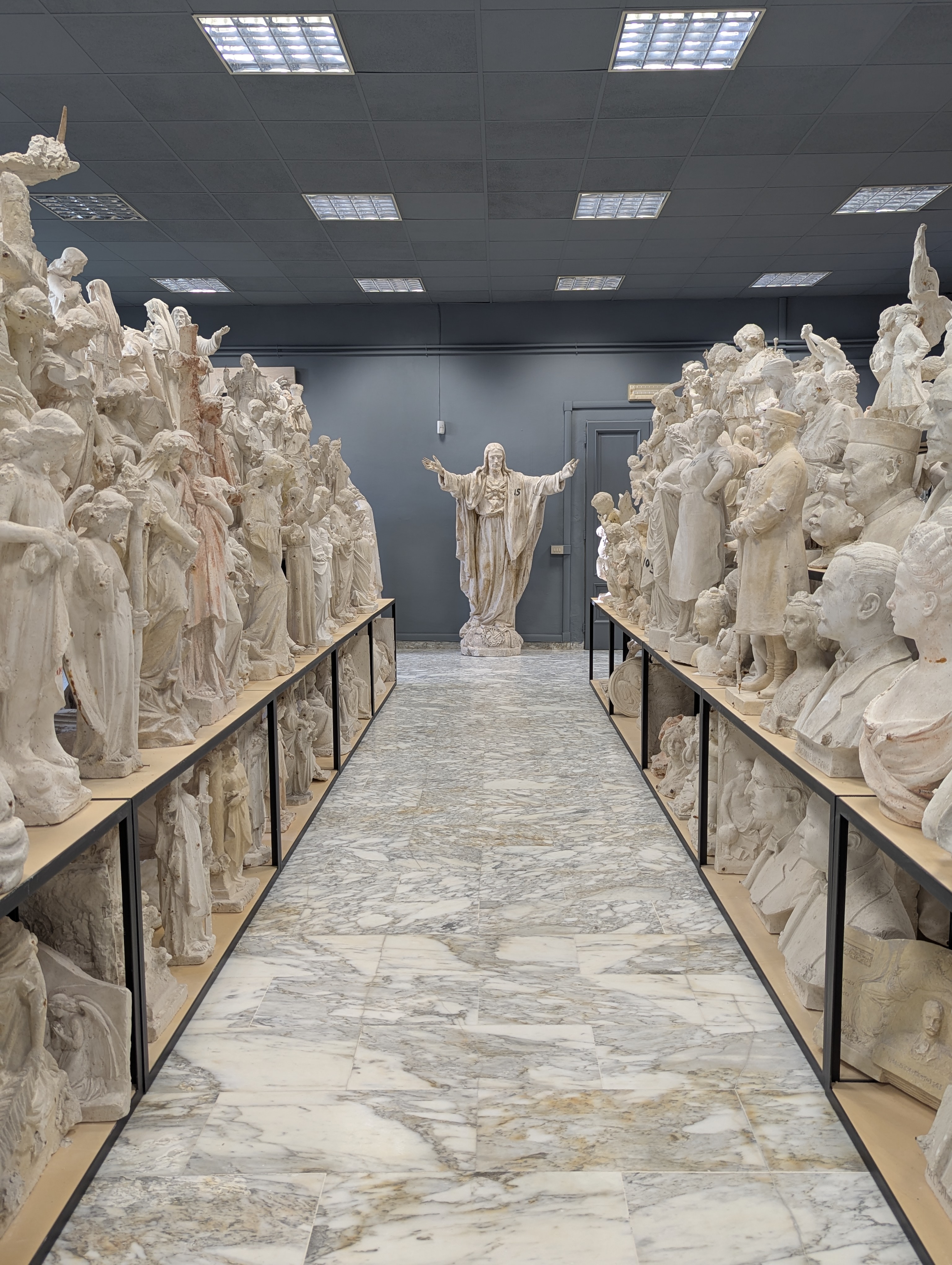
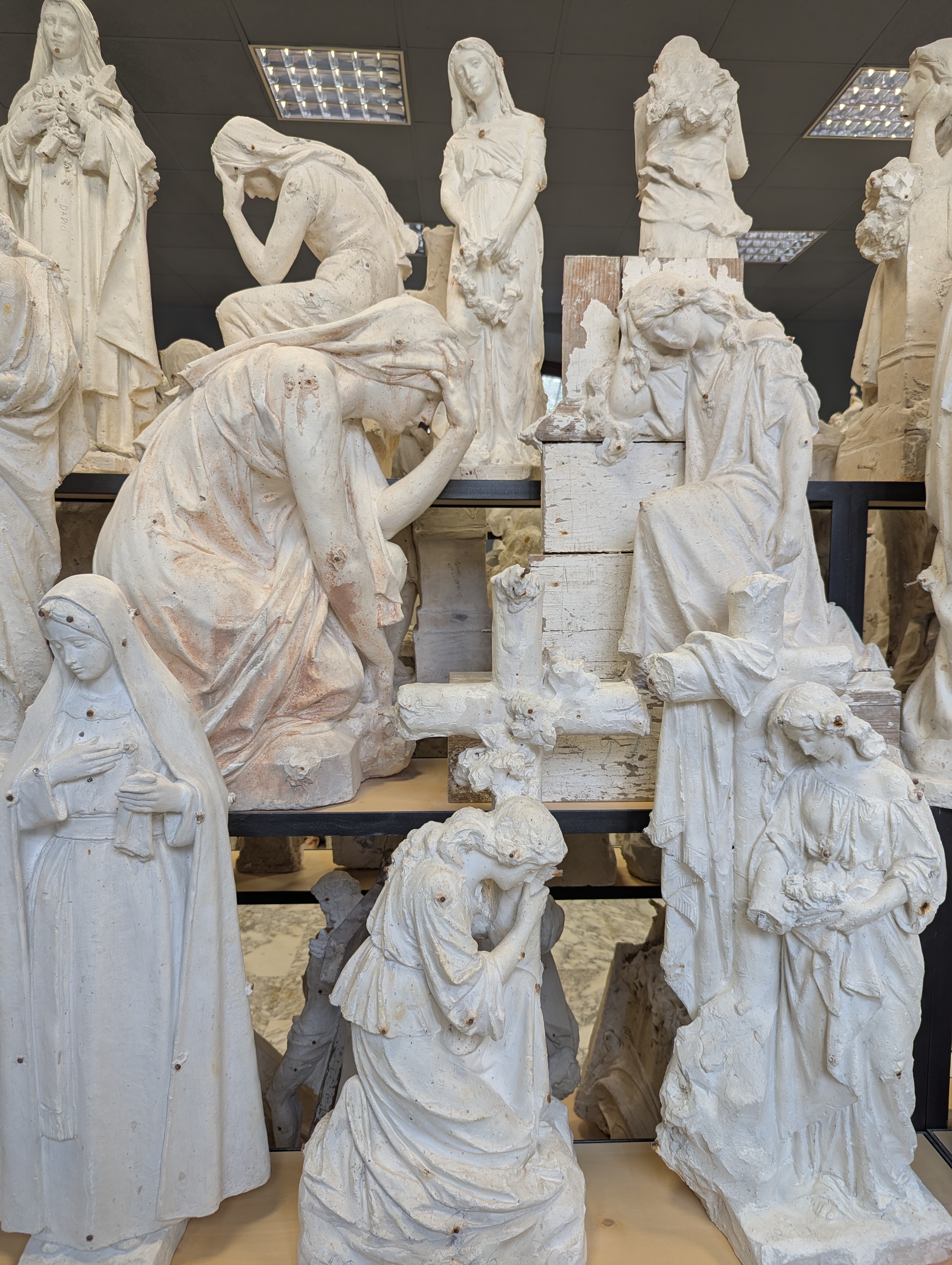
While avant-garde sculptors from around the world have made Pietrasanta their foundry and workshop of choice and even their home (Polish-born Mitoraj lived here for 40 years and is buried in the local cemetery), the local trade has been here for hundreds of years since Michelangelo and his peers veritably rediscovered the art of classical sculpture that had lain fallow during the medieval period. Accordingly, there is a storage room where more popular “genre studies” are stored, ornaments for local gravesites and gardens—no gnomes or lawn jockeys, but a profusion of pleurants and puttis. On their surfaces, you can see the metal studs that guide their replication in marble. The room for these in-demand sculptures—off to the side of the more experimental loggia—is lorded over by a singular figure of Christ, as if to forestall accusations of idolatry by not multiplying him too insistently. He’s also maybe there as the chief resurrector of all forms.
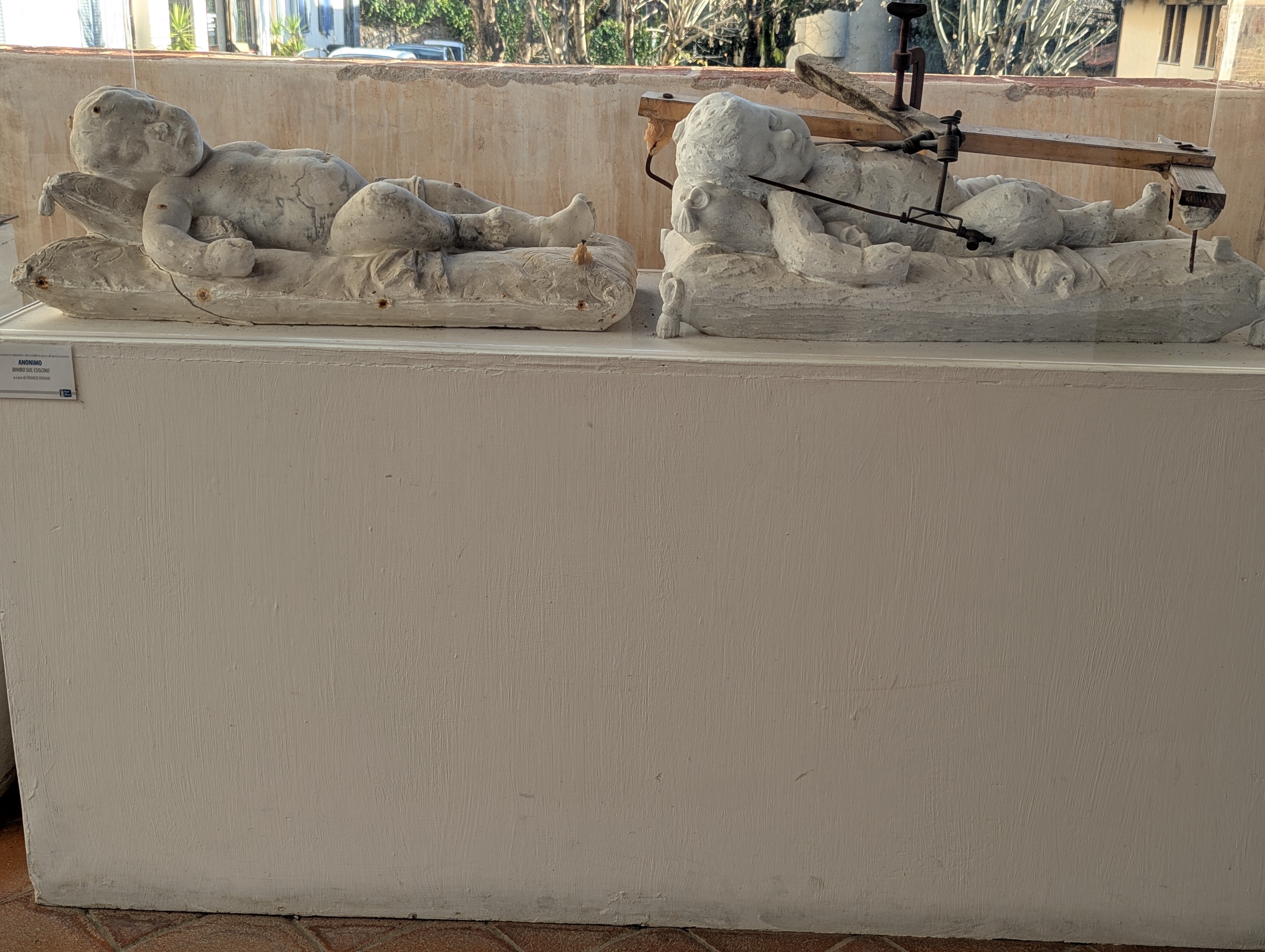
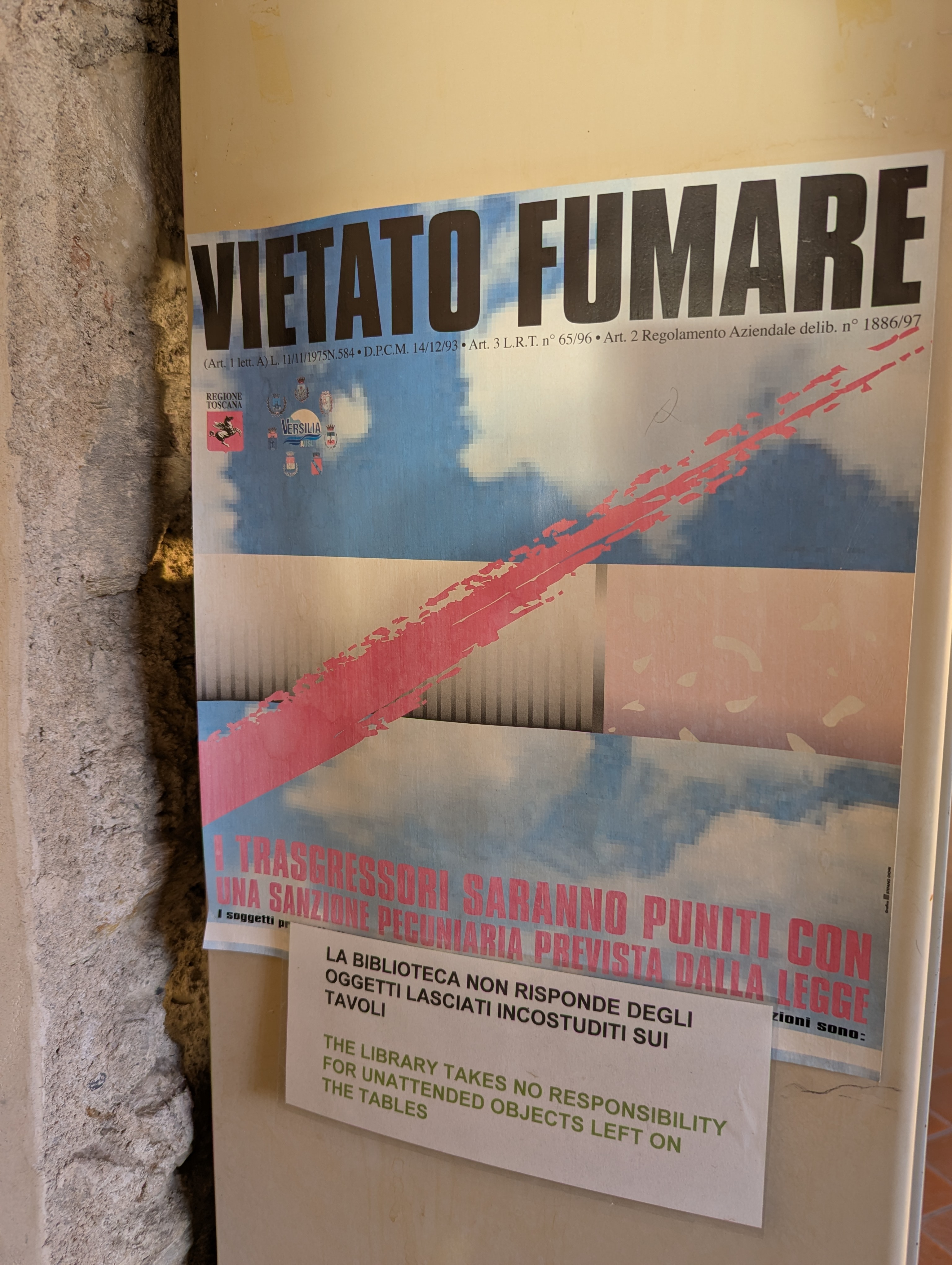
Another meta moment: upon reaching the loggia of the second floor, the visitor is greeted by a pair of identical infants on cushions, one with the calipers of the pantograph still attached to the body. The reproduction of sculpture by way of the pantograph as a guide tool is here made into a metaphor of creation as a more profound replication of being. This second floor continues the collection of bozzetti, but is also a library and study center, probably the most amenable location for research I’ve seen, with stylish pendant lamps of racecar red hanging from Tuscan wood beams. The “No Smoking” signs look like a cover of Artforum from 40 years ago.
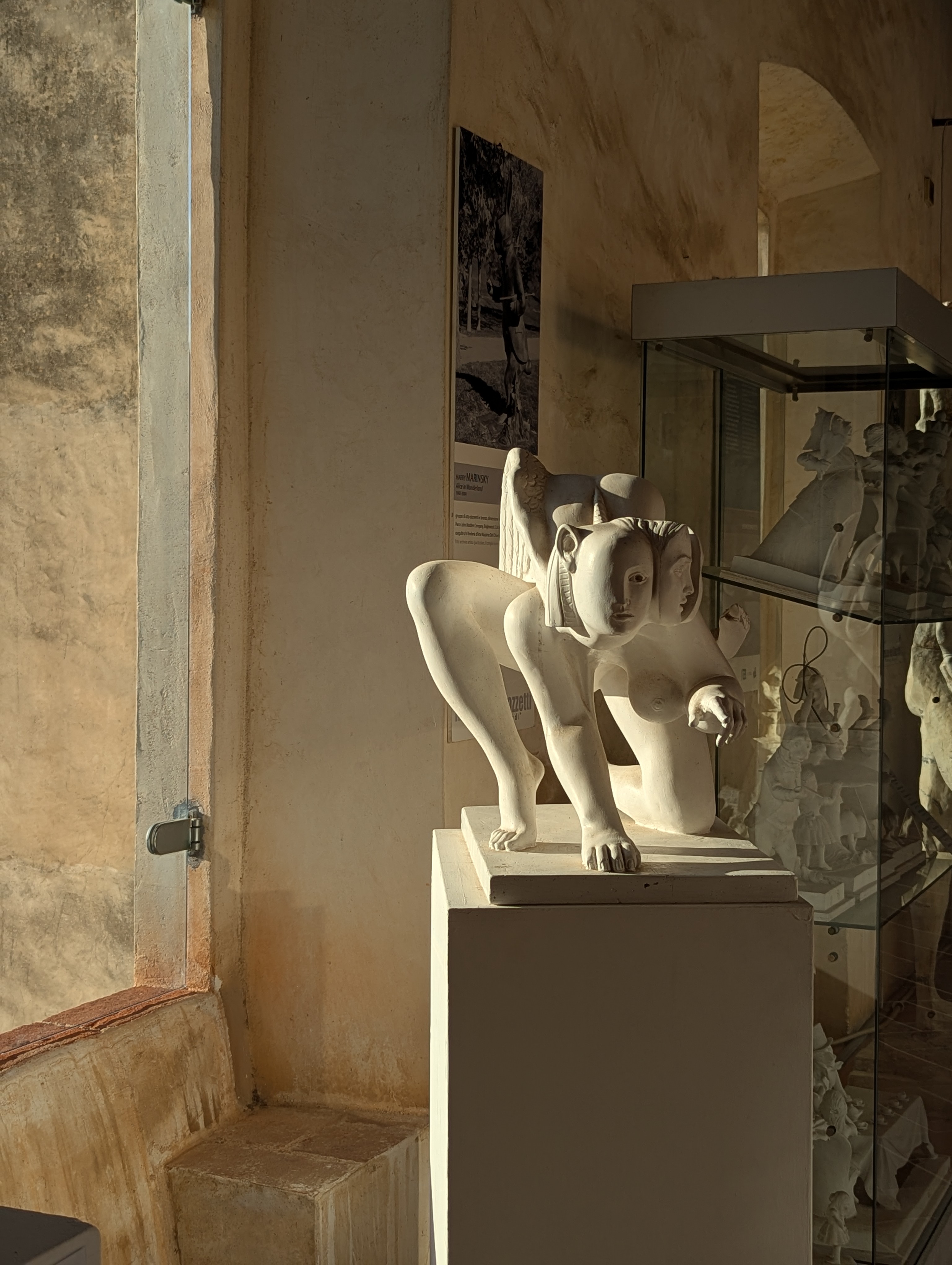
Here and there, the plasters continue, plans for minimalist piazzas in rural France (Serge Boyer’s Piazza Saint-Just), a triple-headed sphinx (Alba Gonzales’ Sphinx and Dove), superflat sculpture (Pietro Consagra’s Green Marvel of Mexico), and all manner of non-anthropomorphic oddities (e.g. Jørgen Haugen Sørensen’s The Angular Ones Carry, The Smooth Ones Slide, the final form of which is installed against a brick wall in Copenhagen as if shoehorning itself into Euclidean space). There is another Mitoraj, more wounded lover-angels with heads within heads. His Birth of Venus seems more compelling than the online images of its bronze counterpart in Sicily, if only because the gesso version retains the ephemerality of a sketch, complete with pencil marks that remind us that the “birth” of this busted-up goddess was here.

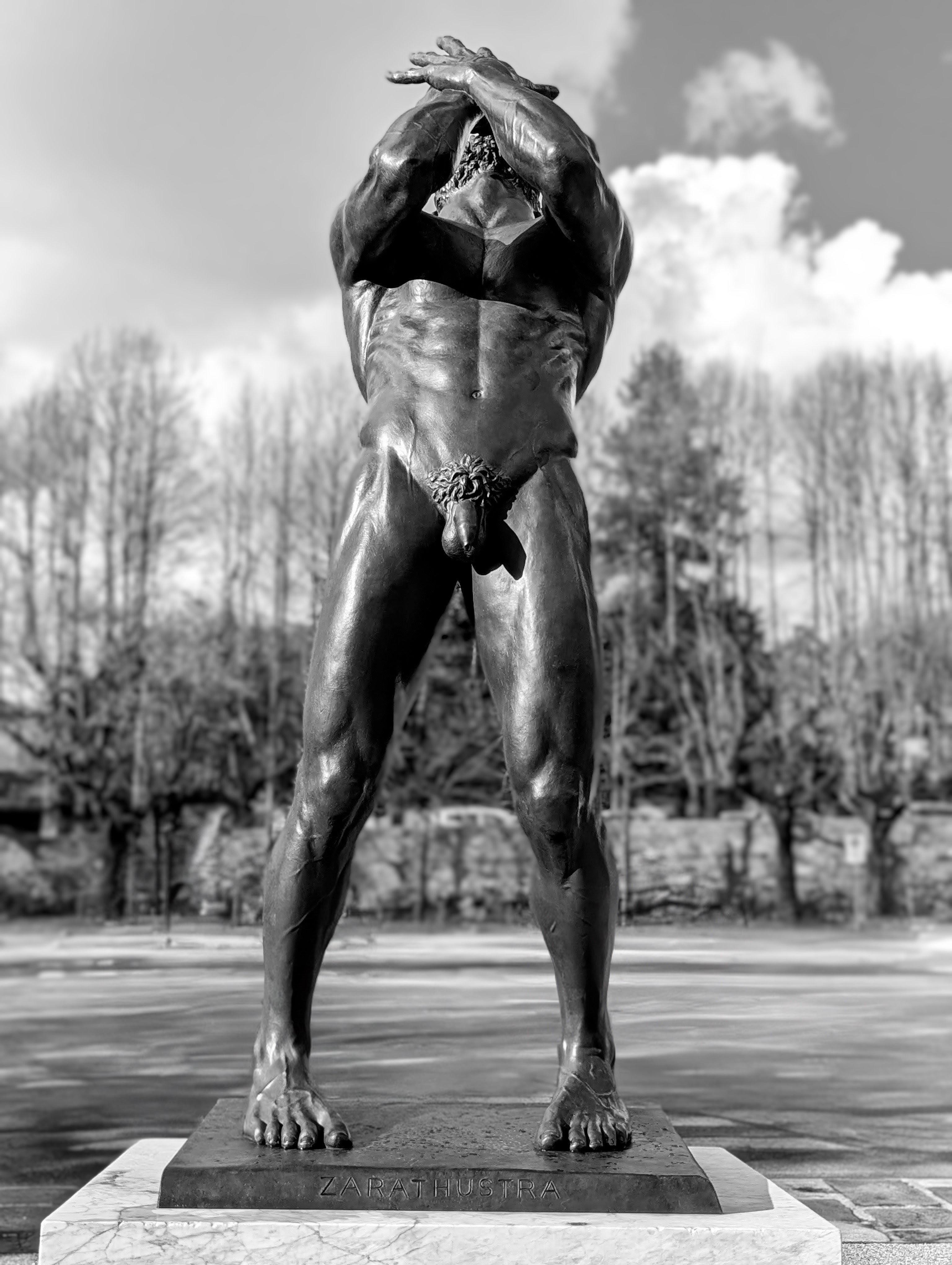
My hesitant stop in Pietrasanta has now filled the day, and I make my way back to the parking lot. I am now prepared to better appreciate the sculpture that dots the periphery there, including a Zarathustra by Peter Schipperheyn. This depiction of Zarathustra has what seems to be a Jesus-face, but that face is upturned, evading scrutiny. Perhaps this is a sign that true idols (or eidola) keep their distance from mere curiosity. The Übermensch is incommensurable with the American art-cow ideal of public sculpture. Access is overrated, and even damaging to transcendence, to art, to self-realization itself.
However, this difficulty-of-access might be short-lived. The new Igor Mitoraj Museum in Pietrasanta opens to the public on June 6, and you can see it taking form on the path where the nonna makes her way with a bag of chicory.

.jpg)